


Across the Arab world, modernist artists didn’t just experience and respond to violence, they documented it.
Whether living through war and conflict in their home country, in exile, or in diaspora, Arab modernist artists of the 20th century expressed the devastation of their countries and cultures through their work.
Across styles, influences and personal obstacles, their work captured what history books aren’t able to. How it felt to live through destruction, to grieve publicly and privately, to search for meaning in the aftermath, and also to hope.
These paintings are not passive records. They’re urgent, emotional testimonies, messages and stories.
Through this collective process they forged a uniquely Arab visual language for grief, defiance, and memory.
During this urgent moment in the region’s history, its vital we learn about these artists and these works to share and celebrate them.
While cultural appreciation and archiving how political and social moods influenced the trajectory of these artists is important, placing focus on works by Arab artists that are anti-war and anti-violent, is also a way of affirming that, despite decades of conflict, the region’s art continues to search for reconciliation, peace, justice, and truth.
From cubist figuration and expressive brushwork to minimalist abstraction and references to ancient regional iconography, here are 13 anti-war paintings by modernist Arab artists, that share histories and stories that are too complex for words.
The Dinshaway Massacre by Inji Efflatoun, 1950s
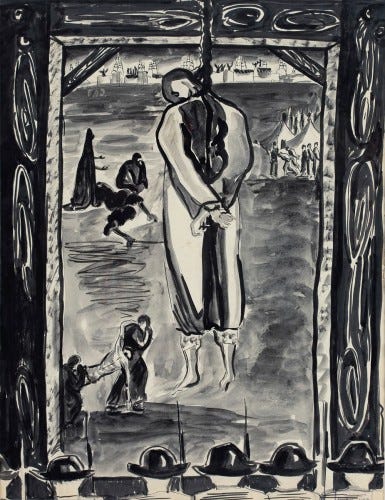
Egyptian painter and activist Inji Efflatoun channels fury into form in one of her most powerful works. The Dinshaway Massacre uses expressive brushwork and a black and white palette to recount one of Egypt’s most traumatic colonial events.
Painted in the 1950s, the work references the 1906 incident where British authorities staged a brutal public trial, executing four villagers and flogging others, sparking widespread outrage and becoming a turning point in the Egyptian nationalist movement.
The painting depicts one of the executed villagers as the central figure, the back of his hanging body facing the viewer. Framed at the lower half of the work are British soldiers, depicted as faceless oppressors while the background of the work shows villagers wailing in grief and pain.
Efflatoun was a committed Marxist-feminist and former political prisoner making the anti-imperialist stance in her works both political and personal. She doesn’t depict the armed conflict in a glorified way but paints its aftermath, where civilians and ordinary people are tortured and killed for resisting occupation.
Grief by Mahmoud Sabri, 1960s
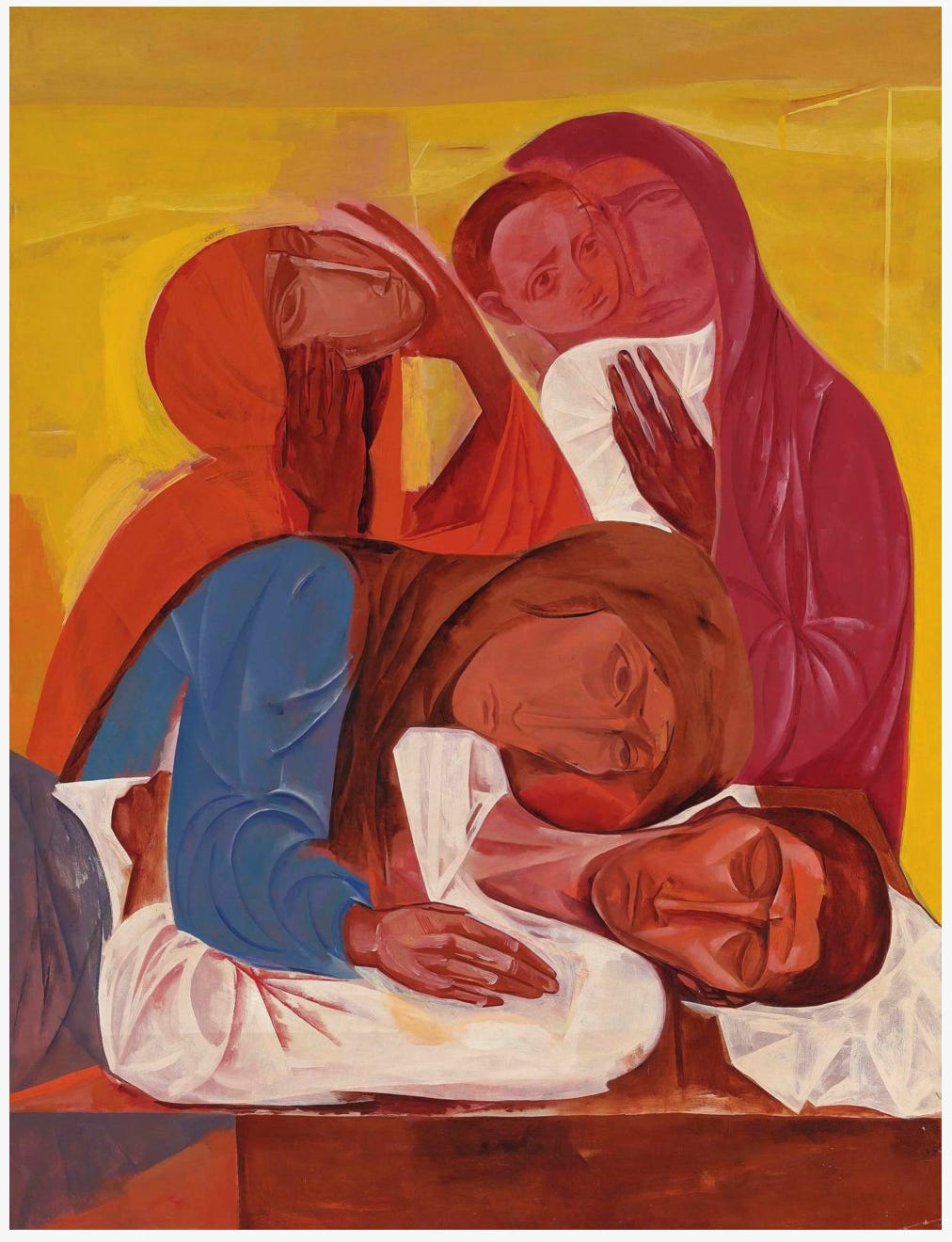
Part of his Funeral of the Martyr series, pioneering modernist Iraqi artist Mahmoud Sabri’s painting Grief is an emotive portrayal of collective mourning. Painted some time in the 1960s the work depicts a body surrounded by three veiled women and a child, their faces frozen in mourning and anguish.
Grief reflects the political violence and upheaval of Iraq’s post-monarchy years that Sabri, a committed leftist, felt should be documented through art.
Though not referencing a specific incident, it’s believed that Sabri was greatly affected by the death of Numan Mohamed Al Saleh, a young man who was proclaimed a martyr after riots over prison conditions broke out in 1953.
Al Saleh’s funeral was attended by thousands of people to protest their defiance against the regime, dependency on the British, and to revolt against the living conditions of the working class.
In Grief, Sabri presents the aftermath of violence, centring it as a silent but powerful protest. Through figuration and emotional clarity, Grief refuses to glorify conflict, choosing instead to dignify its victims.
Then What?? by Louay Kayyali, 1965
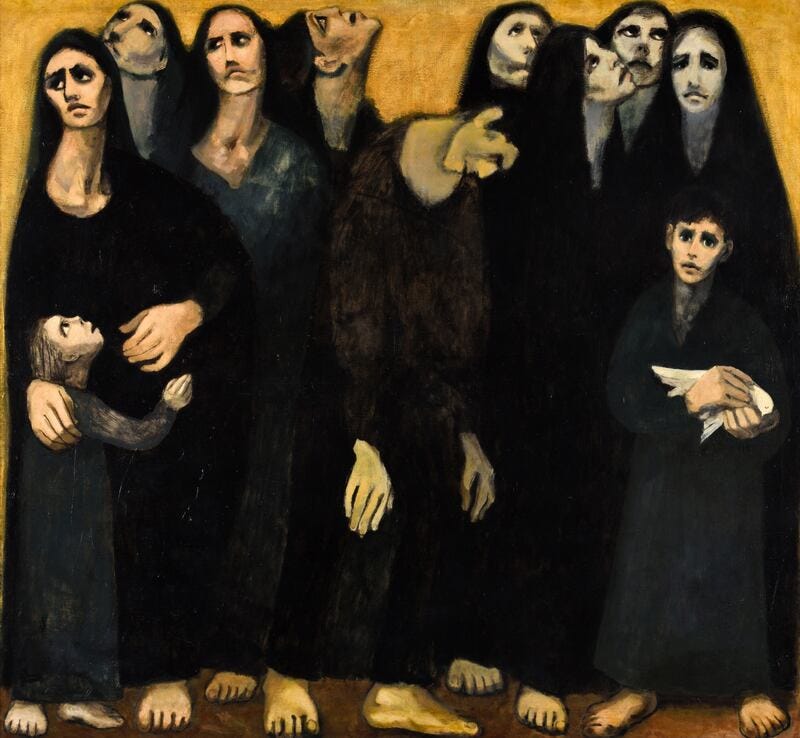
A procession of worn faces seem to walk across the canvas, halting in front of the viewer. Women clutching children, a bent man staring downward, a figure reaching toward the sky in silent agony, this oil-on-canvas work by the Syrian painter Louay Kayyali captures the weight of despair and displacement.
Painted in 1965, the scene is crowded but hushed, as if time has stopped mid-march. Kayyali’s arranged the figures in two groups on each side of the frame, with their postures and gazes leading the viewer across the painting until our eyes fall on the only figure staring out at us.
The young boy holds a dove which appears to be dead, his large hands cupping it as its wing rests lifeless over his wrist.
Then What?? is a reference to Palestinian exile and was painted two years prior to the Six-Day War, revealing not only Kayyali’s understanding of the regional political climate but his commitment to depict human struggles and social issues through figurative pieces.
For Kayyali, known for his humanist focus on the marginalized, this remains one of his most quietly searing works.
Bullet Trace by Saleh al‑Jumai'e, 1967
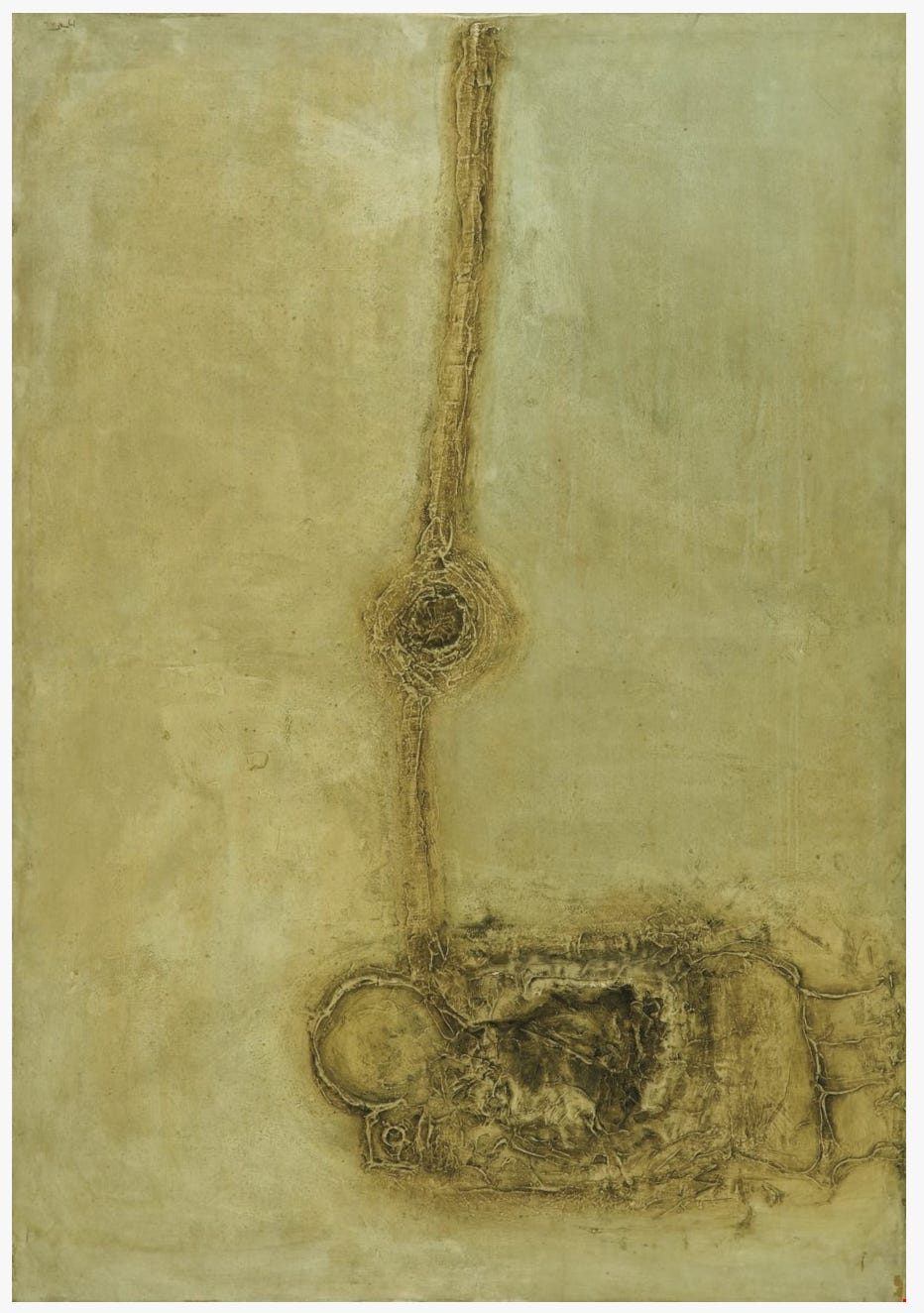
A haunting work that says so much by showing so little.
Iraqi artist Saleh al‑Jumaie’s Bullet Trace is a large work of muted browns and greys dominated by a dark, swirling mass. At its center a rough, jagged, vertical streak cleaves through the work’s surface, echoing a bullet piercing through flesh.
Believed to be a reaction to the 1967 Six Day War, Al-Jumai’e depicts violence without figuration or even blood. He highlights the act, the physical depiction, the psychological scars of violence through an abstract minimalist approach.
Without sensationalism and through a visceral, universal language, Al-Jumai’e makes a powerful statement against the scars of conflict and war.
The Road to Peace by Aref El Rayess, 1976
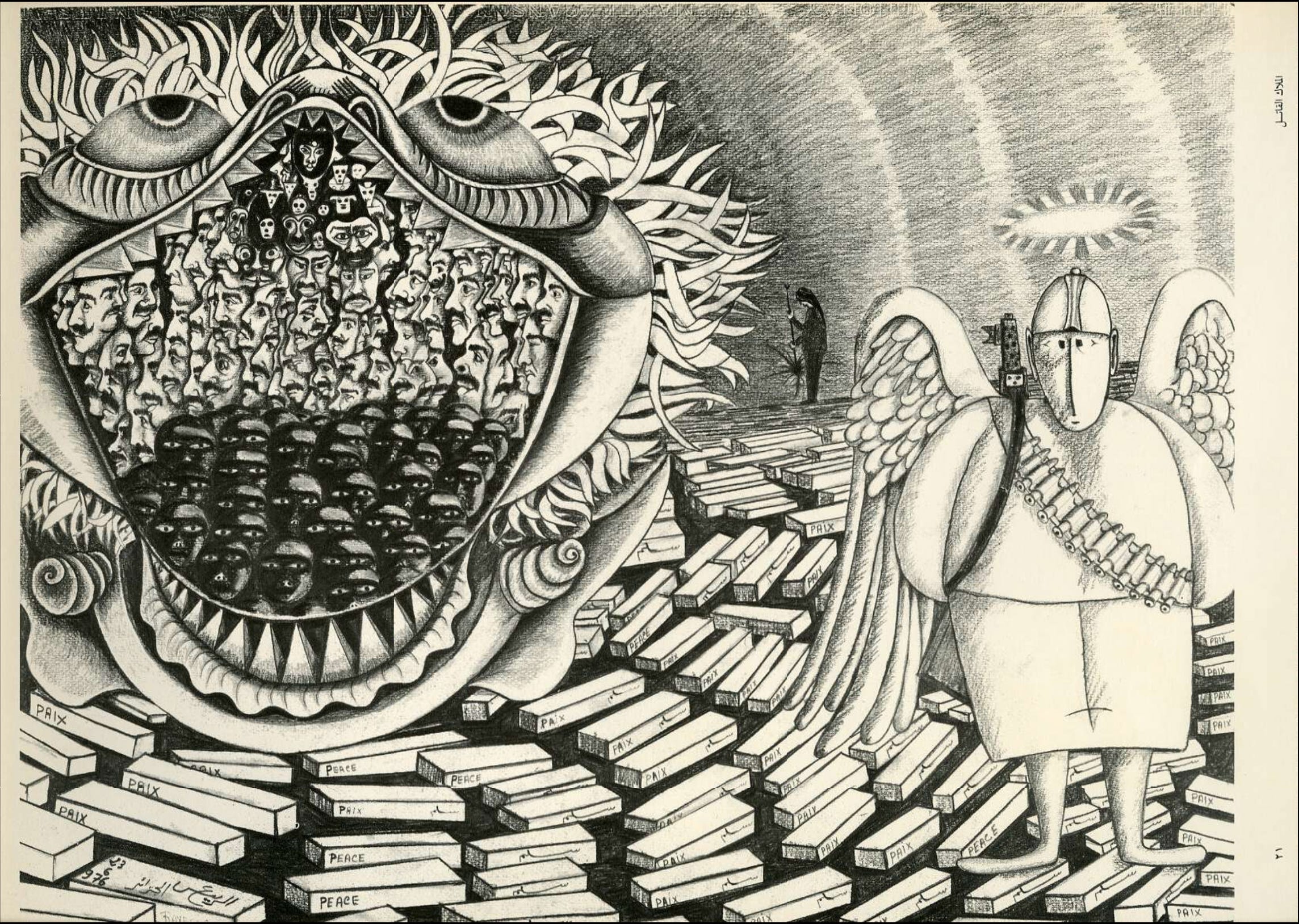
Lebanese painter and sculptor Aref El Rayess combines stark, almost journalistic black-and-white imagery with poetic symbols in The Road to Peace, an artist’s book which features 37 unbound etchings.
El Rayess was in Lebanon at the start of the Civil War which began in 1975, witnessing the collapse of social order, sectarian violence, and the unraveling of Beirut’s cosmopolitan identity. He left shortly after the war for Algiers, Algeria.
During his exile he created The Road to Peace which depicts collapsed buildings, grieving figures, masked combatants in surreal and horrific scenes.
These narratives act as visual pleas to the viewer, where they reject, heroic descriptions and instead focus on the war’s human cost. The Road to Peace is an important work in El Rayess’ style of fusing political activism and artistic expression.
Bahr el Baker School by Nazir Nabaa, 1970
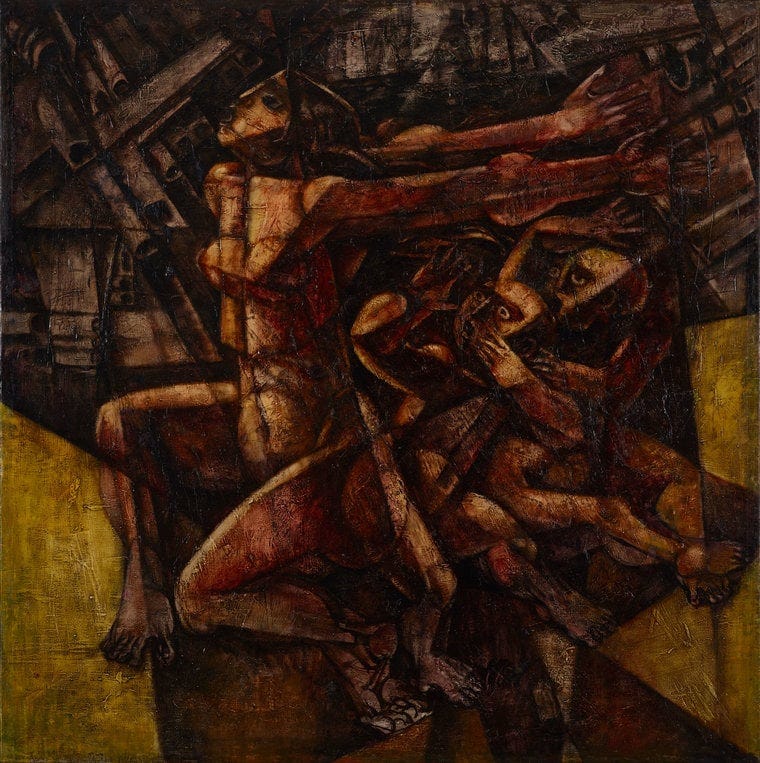
One 8 April 1970, The Bahr el-Baqar primary school in the Egyptian village of Bahr el-Baqar was bombed by the Israeli Air Force killing 30 children.
Syrian painter, Nazir Nabaa channelled and depicted this tragedy through vibrantly fractured forms. Standing tall, her arms outstretched, a woman is the central figure in the painting, shielding two terrified boys among a storm of collapsing buildings.
Nabaa fuses cubism with futurism, a style that geometrically exaggerates form, to more accurately capture tension and the emotions of the figures. The flattened space, harsh diagonals, and rhythmic repetition throughout the work creates a stronger sense of suspense and violence.
Self‑portrait as Man, God, the Devil by Mustafa al‑Hallaj, 1979

A monumental work that depicts Palestinian artist Mustafa al Hallaj in three avatars of himself – as a man, a God and the Devil.
Fusing elements of folklore and myth, the massive engraved masonite, stark black and white work is a telling of Palestinian history. Al‑Hallaj combines fantastic beasts from birds to bulls and mythical creatures with scenes of suffering such as forced marches, mass hangings, and Nakba references.
Al Hallaj depicts himself with enlarged eyes gazing outward in awe and grief as the power, pain and suffering of the Palestinian people and culture unfolds around him.
The work mourns communal trauma and asserts art as a vessel for collective memory and resistance.
Freedom by Sliman Mansour, 1980
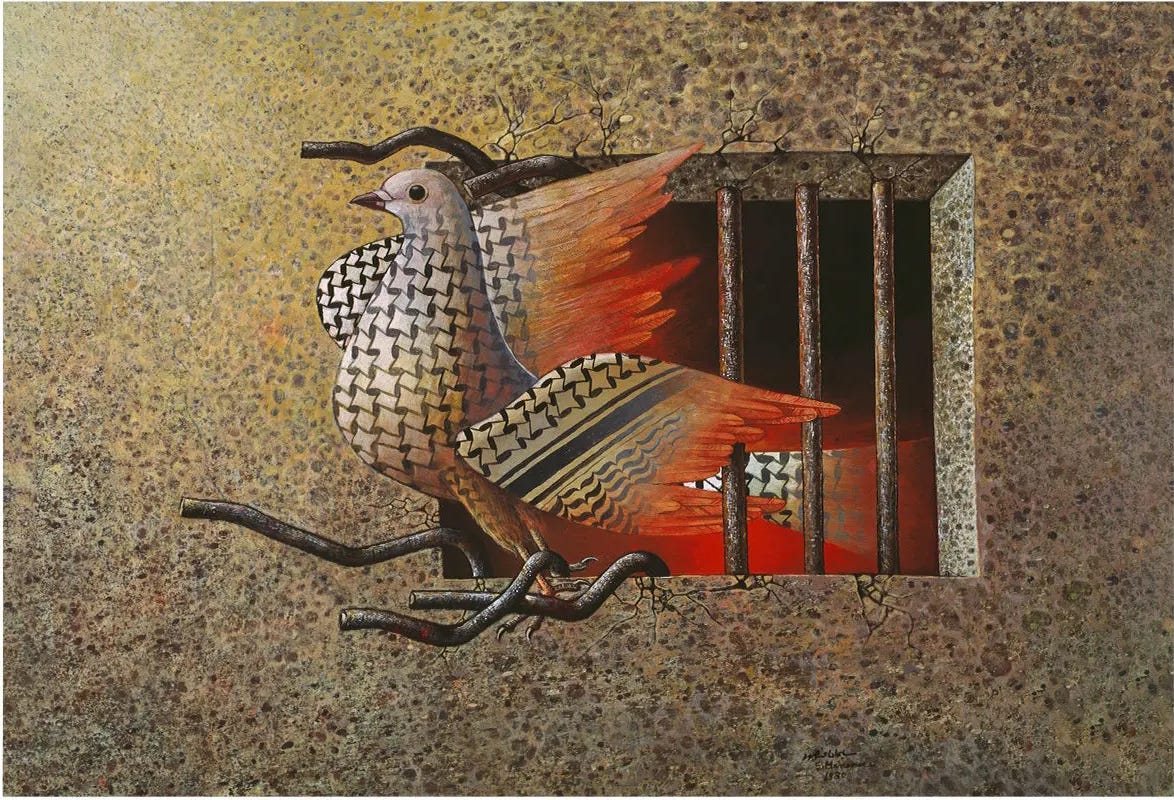
Resistance and hope are in the centre of Sliman Mansour’s iconic work Freedom where he explores Palestinian identity through symbolism rather than overt conflict.
At the centre of the painting is a stylised bird, its body and wings patterned in traditional Palestinian embroidery as it rests against warm ochre tones. The bird, post likely a dove and symbol of peace, is breaking out of a jail, the broken bars transforming into tree branches.
Mansour belongs to the wave of Palestinian artists from the late 1970s who turned to poetic symbolism, such as olive trees, birds, and embroidery to express national identity and nonviolent resistance.
Rather than depicting violence or the effects of violence Freedom express resilience through imagery that represents identity, hope and gentle defiance.
Sabra and Shatila Massacre by Dia al‑Azzawi, 1982–83
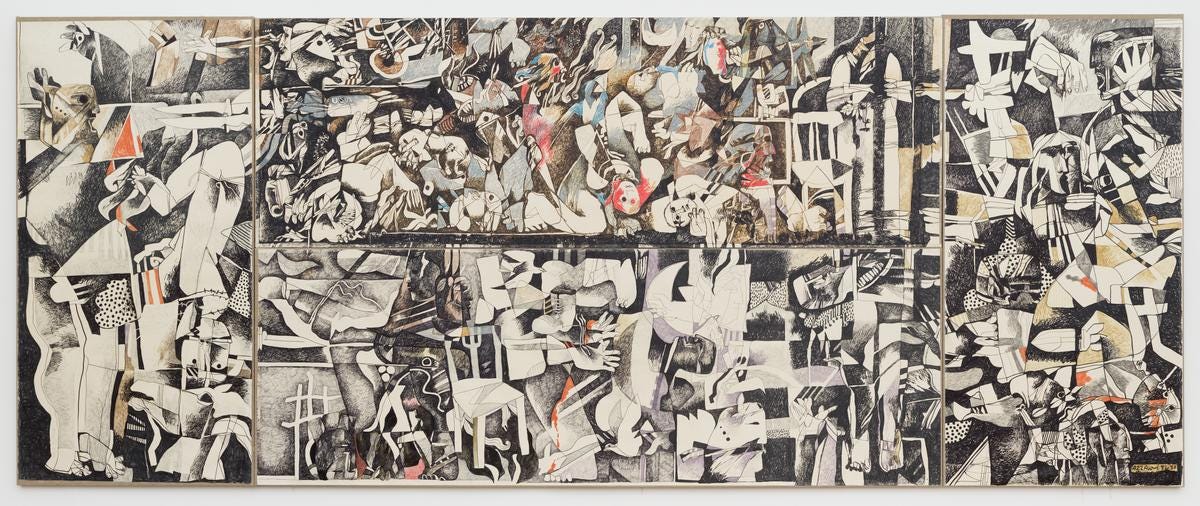
This highly emotive work by the Iraqi pioneering painter Dia al-Azzawi was made in response to the massacre of civilians at the Sabra and Shatila refugee camps in Beirut, Lebanon in September of 1982.
Al-Azzawi was moved by French writer, playwright, and political activist Jean Genet’s Four Hours in Shatila, an eyewitness account of the massacre which he wrote after visiting the Sabra and Shatila refugee camps.
The expansive four-panel composition offers no beginning or end. The viewer is immersed in images of dismembered bodies, raised hands, barbed wire, weapons, and domestic remnants.
The work is made of ink and wax crayon on paper mounted on canvas where the cubist influenced imagery is visceral, revealing the horror of the massacre of Palestinian and Lebanese civilians by Christian militias with Israeli complicity. It offers no hero or triumph, its anti-war message lies in it demand that we stand witness to the endless cycle of violence.
Prison by Sliman Mansour, 1982
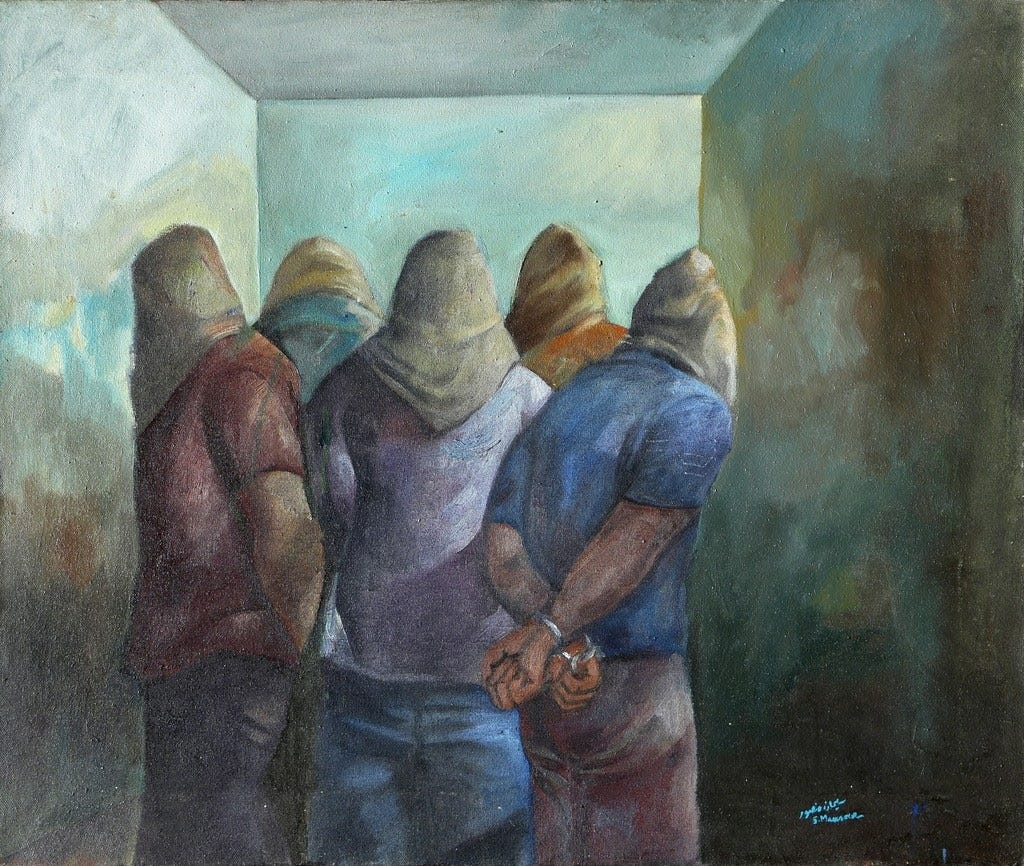
Another work by Mansour, but one whose tone and execution differs from Freedom.
The painting depicts five hooded, handcuffed men standing back-to-back inside a confined, bare cell. Their anonymity gives them symbolic weight, they become stand-ins for countless of Palestinian detainees. Sliman was reflecting the lived reality of political imprisonment of Palestinians during Israel’s occupation in the 1970s and early 1980s.
While it stems from the Palestinian experience, the work takes on universal meaning speaking to any group of people who have experienced isolation or imprisonment for their beliefs and rights.
Rather than dramatize suffering, Mansour paints quiet endurance, depicting dignity and solidarity, even behind bars. It’s a work that is emotionally restrained but still politically charged that attempts to show the power of non-violent resistance.
Martyr’s Widow by Neziha Salim, 1982
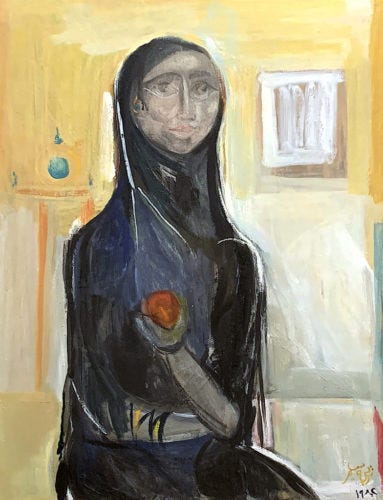
This intimate painting by one of Iraq’s most prominent female artists Neziha Salim captures a moment of grief and inner reflection.
Most likely painted in reaction to a period of political upheaval in Iraq, the woman in the painting is shrouded in black, traditional mourning attire. She’s placed seated off-center in a bright domestic setting, her head tilted upward, as she stares out into the distance.
The light yet muted palette of soft creams, ochres, and browns in the background places the emphasis on the widow, reflecting her feelings of solitude. She holds something red in her hand, it could be an apple, pomegranate, or a symbol of her heart aching for the loss of her husband or even a sign of hope.
The work has no scenes of violence, no dead bodies, or images of a funeral procession. Instead, Salim centres the work around the strength of a woman’s solitude in her own home. She’s honouring resilience and memorialising the personal devastation that conflict ultimately brings.
Lebanon by Nabil Kanso, 1983
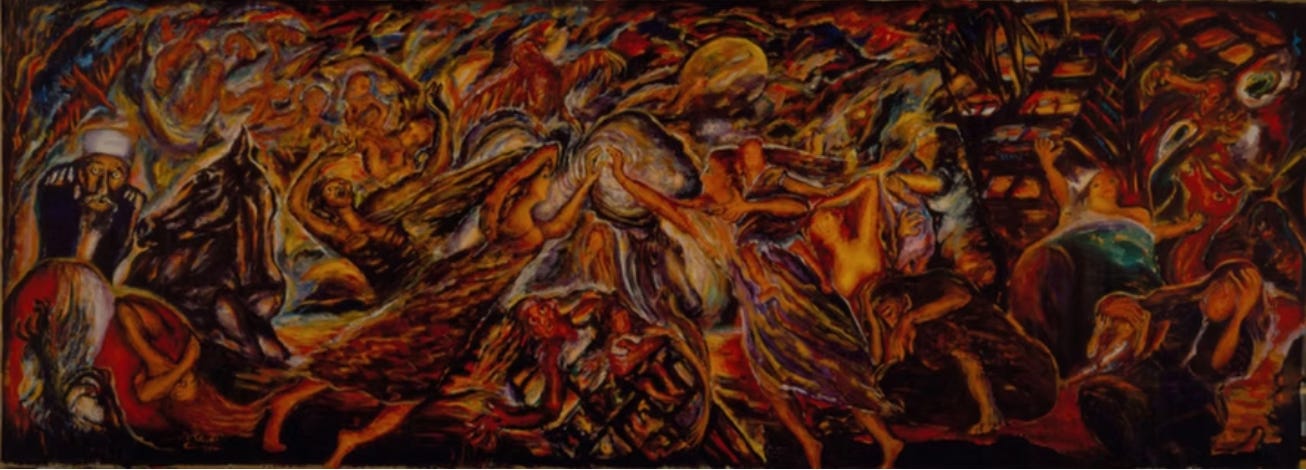
A vast canvas churns with anguish as figures writhe, buildings crumble, and bodies fall through a red-tinged atmosphere. Painted in 1983 at the height of the Lebanese Civil War, this expressionist work by the Lebanese-American neo-expressionist painter Nabil Kanso, conjures the horror of Beirut’s descent into sectarian violence.
Two ghostlike female figures reach toward a dim halo of light, surrounded by a vortex of fire, limbs, and shadowed architecture. Kanso imagines war not as history, he doesn’t document it, but renders it as an emotional storm.
The painting doesn’t depict a single moment, it’s an accumulation of emotions, overwhelmingly so, despite being singed by some hope as seen by the two central female figures.
War Painting by Afifa Aleiby, 1991
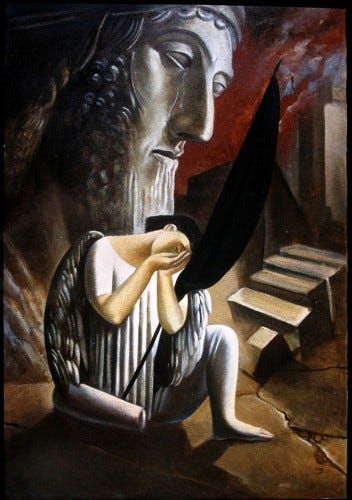
A carved Sumerian head, once stoic and eternal, has tears flowing down his face. The sky in the background is blood-red, in the foreground a figure, part human part ancient sculpture, has her face in her hands, weeping while a black flag hangs from her arm.
Painted in 1991 during the Gulf War, this oil-on-canvas work by the Iraqi artist Afifa Aleiby mourns the destruction of Iraq, not just its people, but its history and cultural soul. The piece is modest in size but monumental in implication: war doesn’t only claim lives, it erases culture and civilizations.
By placing an artifact at the center of her protest, Aleiby collapses thousands of years of history into a single, shattering moment.