


Anne Hathaway is the moment. She has been for a while. If anything, 2026 continues to prove her talent and range as an actress and cultural icon.
There was Mother Mary in April a compelling film that didn’t get the attention it deserved, then we had the long awaited (whether you enjoyed it or not) The Devil Wears Prada 2 in May followed by the epic critical and commercial success of The Odyssey in June, and now the recent release of the sci-fi survival film The End of Oak Street, and in October, Hathaway will star in the Colleen Hoover psychological erotic thriller Verity – give me a minute I need to catch my breath, did I miss anything?
Oh yes, she also announced that she is pregnant with her third child in a super cute Instagram video in June.
This is not even including what projects Hathaway is working on now – Princess Diaries 3 (will be huge) and Yesteryear the trad-wife thriller based on the hugely successful (and polarising) novel by Caro Claire Burke.
Aside from the obvious, (booked, busy, refusing to stop impressing us with her work ethic) Hathaway, has also done an excellent job at entertaining the internet through the many memes she has inspired.
Meme Muse
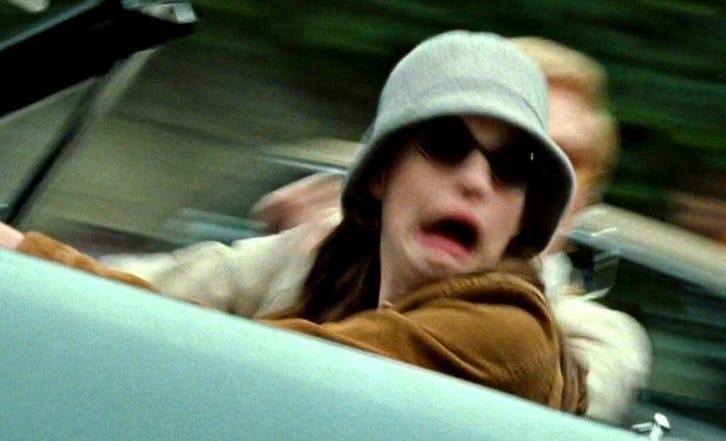
Here is where Hathaway rises a distinct notch or two above the rest. I wouldn’t be wrong to dub her one of this generation’s most inspiring meme muses.
The memes come forth in a plethora.
There is her excellent work in the first two Princess Diary films and The Devil Wears Prada (the sequel is yet to yield anything meme or viral worthy), a collection of looks and poses on various red carpets, there is also the one of her holding a champagne glass from the film The Hustle, and the promotional photo from the 2009 Shakespeare in the Park production of Twelfth Night – I could go on.
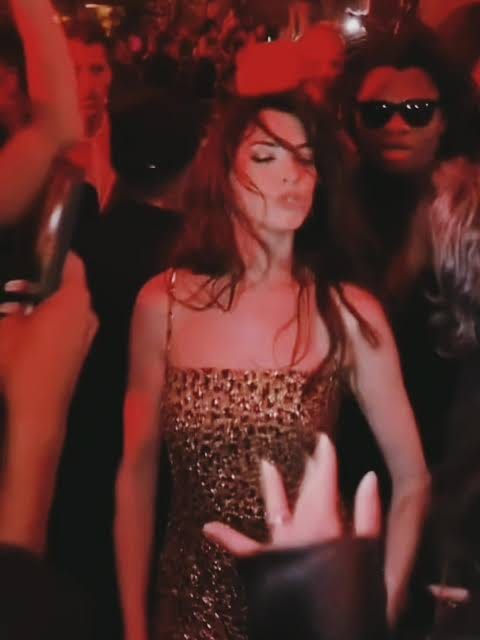
My personal favourite is when Hathaway went viral in 2023 for dancing to Lady Marmalade at the Valentino after-party at Paris Fashion Week. That was peak “Ren-anne-aissance” building up from a year where her style revolution had shifted thanks to stylist Erin Walsh, from which she went forth and entered into what fans dubbed the Hathaslay era.
Collective culture propagating on the internet truly is a fascinating thing, a collection of language, content, and movements, that tsunami over us before receding back into the horizon.
Wondrous really.
Often or not though, we never consider or know the story behind a meme.
Like a cultural archaeologist brushing away the dust and debris of the internet’s reframes, revisions, reshares, and of course the comments, discovering the origin story of a meme can be satisfying and enlightening. The circumstances in which an image has become relatable enough to millions of people online when the framework behind the original is rearranged can be unexpected.
In some instances, the story is a telling reflection of facets of culture that feel frustratingly unfair.
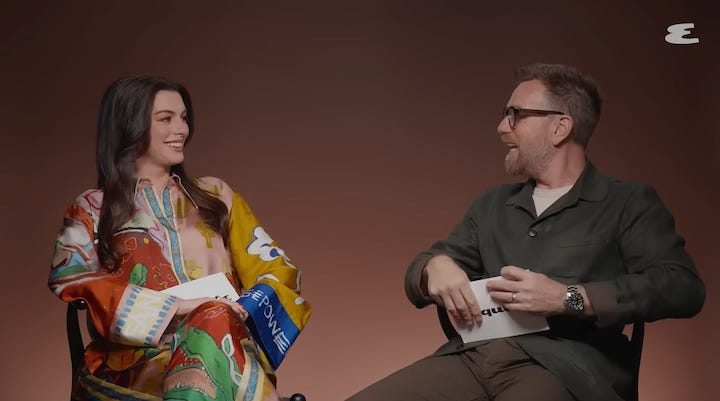
Last week, Hathaway sat down with Ewan McGregor as part of the press tour for the aforementioned film The End of Oak Street. The Esquire video conversation between the two has since gone viral for one of the questions McGregor asked Hathaway – what is your favourite meme of yourself?
Hathway had two. Below are the memes and her response:
The Cupcake Meme
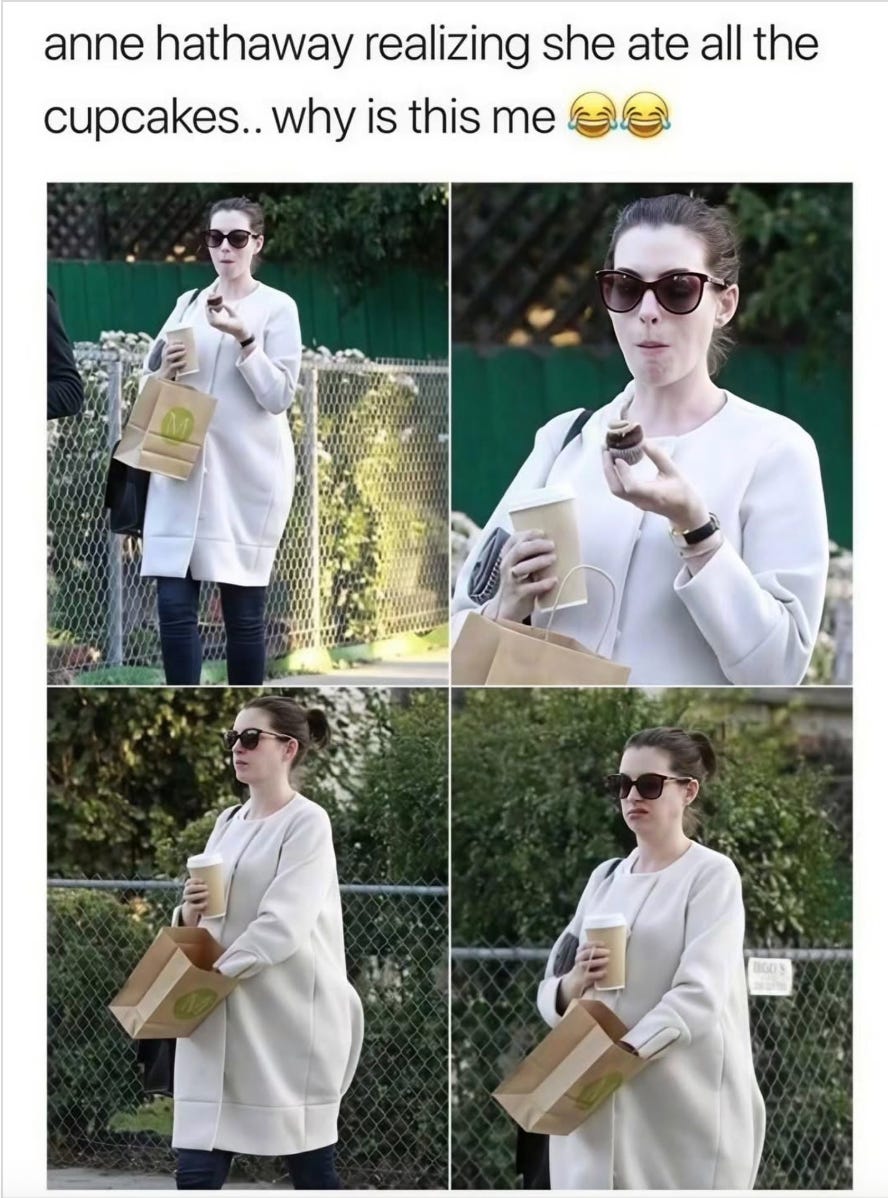
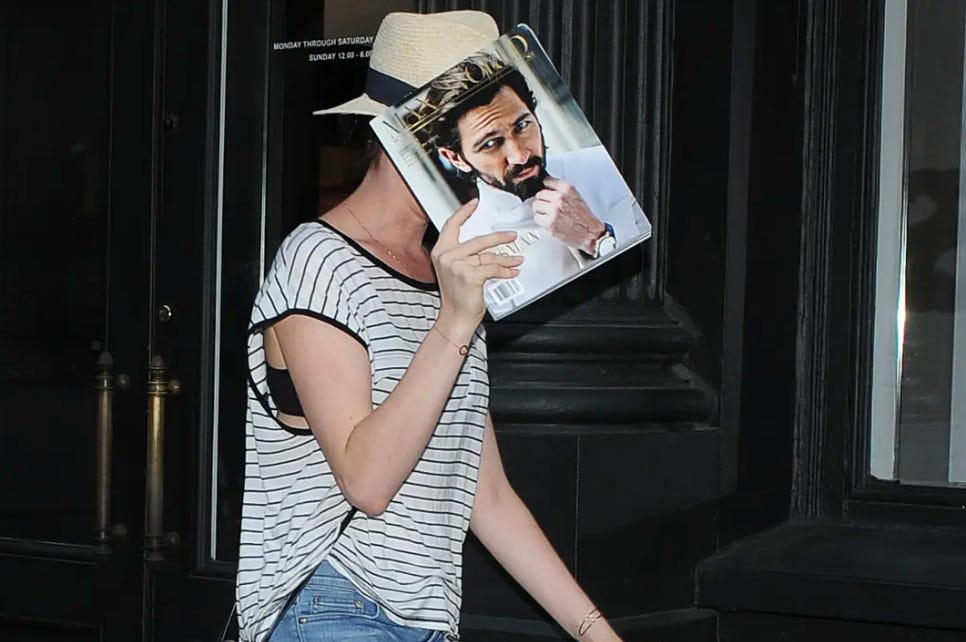
“So, there was this one where I was walking down the street. I was early to go to the gym, and did I get on a piece of cardio equipment? No, I didn’t. There was a bakery around the corner, and I bought a cupcake. And they gave me a bag, and I thought, OK, that’ll be my reward after I work out. And mind you, I’m seven months pregnant.”
She continues:
“I’m walking down the street, I’m like, I’m just gonna eat the cupcake now, and then I’ll burn it off!” she recalled. “I start eating the cupcake, only to realize I’m having my photograph taken by a pap.”
Hathaway adds that she looked at the photographer and made a disappointed face, which was then memed as, “me realizing I ate all the cupcakes.”
The HR Meme
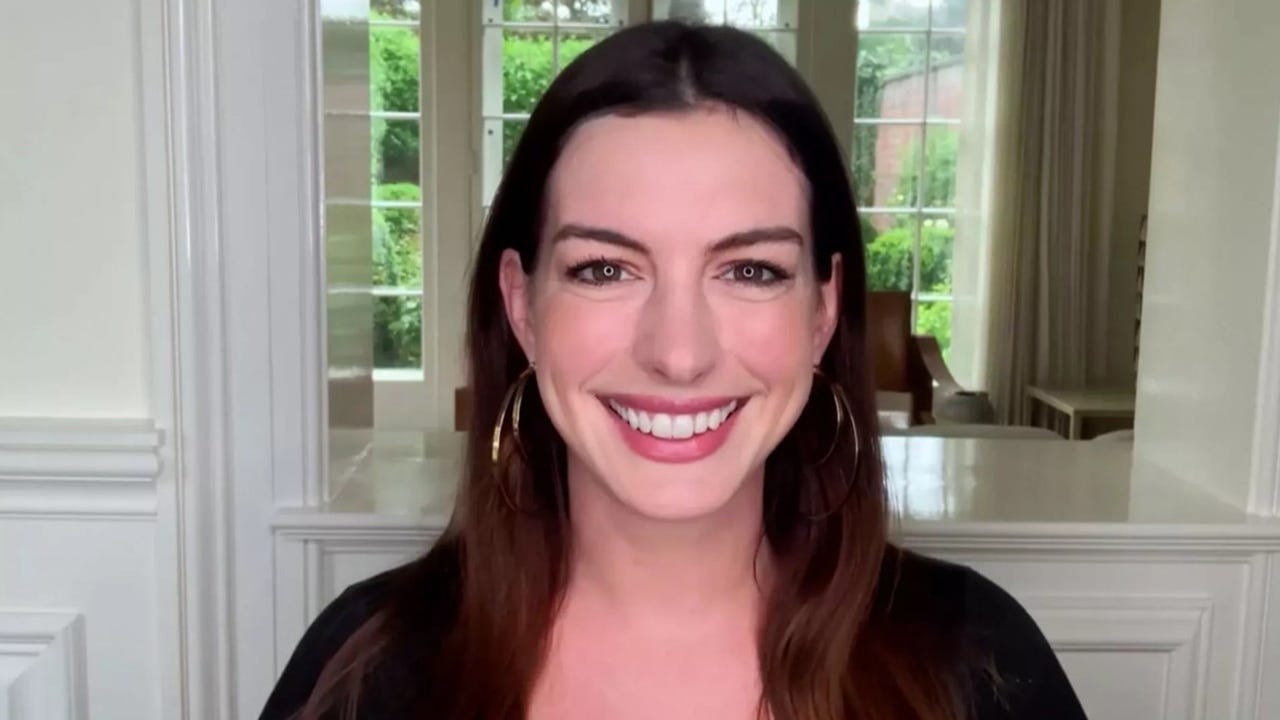
The origin of the meme is when Hathaway made a virtual guest appearance on RuPaul’s Drag Race.
“It was during the pandemic. I was doing this Zoom, and I had a panic attack. I just flushed from here to here,” she points toward her neck and face. “I started sweating, and my hair got really matted to my head, and I just smiled. And somebody made me, like, the forever face of HR telling you you’re about to be fired. Because the smile goes nowhere near my eyes.”
Hathaway discusses the two memes and the stories behind them jovially, the internet generally praising her for being a good sport. And Hathaway is a good sport, an excellent one really.
But why does she have to be?
Behind the Meme: Portraits of Control
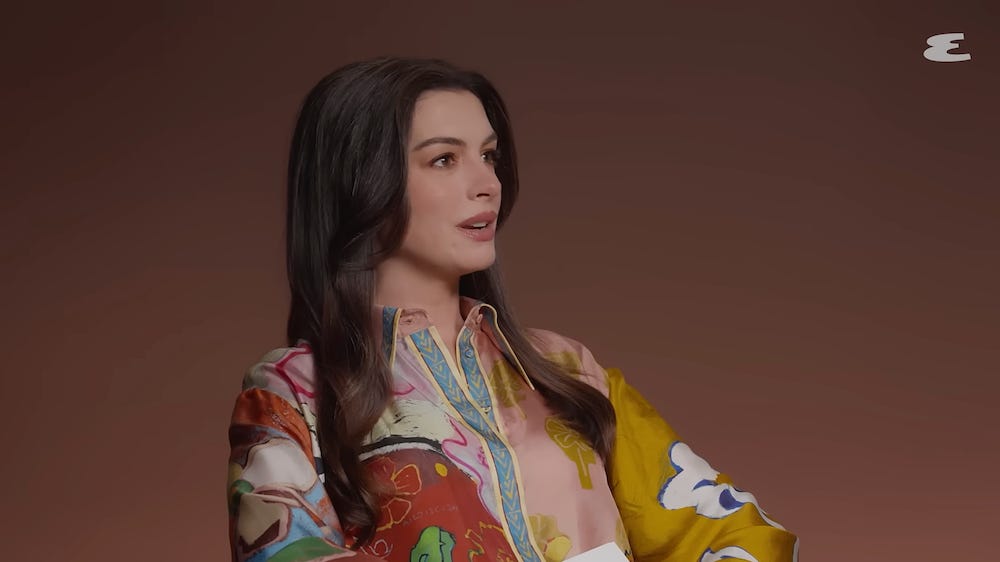
While one can’t deny the interest in listening to the story behind any meme, and to be fair Hathaway’s explanations here were entertaining, my thoughts focused out towards more big picture stuff. And the view was rather bleak.
The two meme’s Hathaway chose were the two that to me follow a theme of control. One letting go of control the other an attempt to harness it.
Convincing oneself that they will work out, that they deserve a prize for sweating it at the gym, and then eating the prize before the work out, is rooted in relatability. Add the pregnant, dressed in workout clothes, munching on said cup cake, along with the “aw, no more cupcakes?” expression, the story then speaks to different sets of very specific groups of people.
In an incredibly normal moment of existence, a moment that may have only last a few seconds, Hathaway shed the glamorous aspirational Hathaslay alter ego to be every person, every woman. While she wasn’t acting, Hathaway became a character many can relate to, an avatar of experience that we are already familiar with.
The cupcake meme, in truth reveals a woman letting go of control, prematurely rewarding herself, having a very mundane and yet human moment. This is why the meme works so well.
The HR meme however, while hilarious, feels darker.
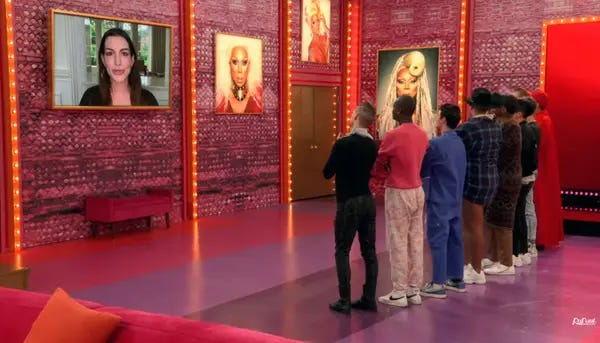
Hathaway was having a panic attack while filming. A panic attack in any circumstance is an absolutely claustrophobic and horrendous experience. Having to control it and you spiralling while performing would feel worse.
The public obviously had no idea that Hathaway was suffering from a panic attack (and one has to also question whether they would care if they knew) and her dead pan smile triggered a familiar image across corporate life.
Through Hathaway’s desperate attempt to control herself in a moment of mental anguish, a portrait of something much more sinister, and unfortunately, relatable, emerged.
The veneer of joy, warmth, civility stretched across something hollow, unfeeling, descending.
Does the analysis of these memes warrant a conversation on whether or not Hathaway is allowed agency on how her face and person is being used in the online public arena?
Does celebrity status mean that we are allowed to praise, drag, or use a person as per our whimsy?
I hate rhetorical questions, but here we are.
Lest we forget, Hathaway was not always as beloved as she is in this moment, not always able to speak about less flattering images of herself in cheerful and breezy cadence.
From Hatha-hate to Hatha-slay
Between 2011 to 2014, Hathaway was the target of public scrutiny and hate.
It began after her heavily criticised Oscars hosting gig in 2011 where she was perceived as too eager next to her co-host the then super cool (now super cancelled) James Franco.
The hate campaign reached an extreme peak during the 2013 awards season. At the time Hathaway was promoting films such as The Dark Knight where she played Catwoman, a role many thought she wasn’t “cool” or “sexy” enough for (I’m glad to report those haters were dutifully proven wrong), and then Les Misérables where her role as Fantine was gaining a lot of critical acclaim, including an Oscar nomination for Best Supporting Actress.
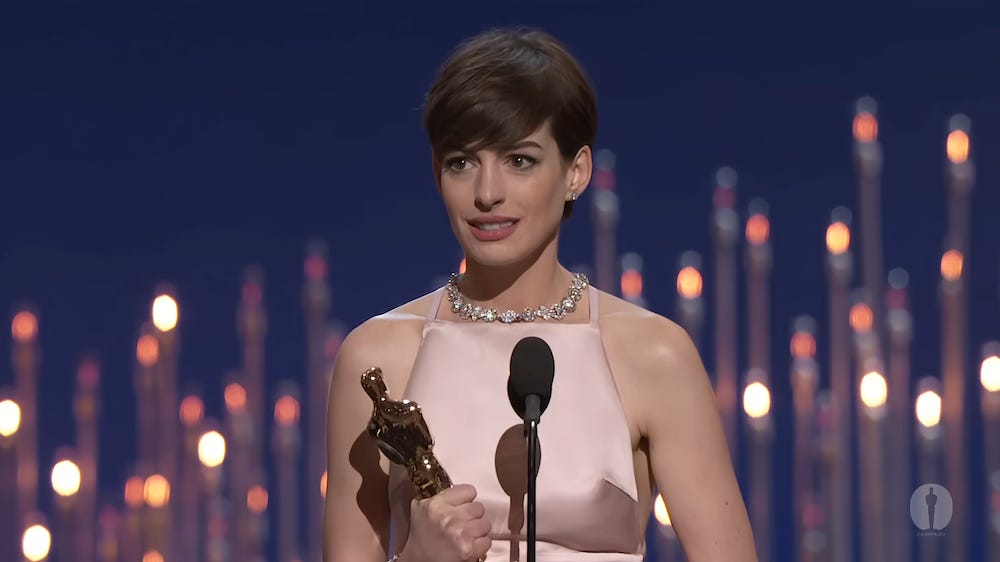
“It came true…”
Were the first words of Hathaway’s winning acceptance speech at the Oscars – a reference to Fantine’s song I Dreamed and Dream. Hathaway then ended her speech with:
“Here’s hoping that someday in the not-too-distant future, the misfortunes of Fantine will only be found in stories and never more in real life.”
This, it seems, was too much for the public to handle.
Social media abuse was relentless as Hathaway swept the award season where her interviews and speeches were dissected by a small but loud and influential group of irritated (and sad) people online that felt she was too keen, too affected, too Disney, to stand.
Looking back now, Hathaway was a delight compared to some of the antics we’ve seen on press circuits over the last few years. A few highlights:
A Star is Born 2019: Lady Gaga and Bradley Cooper baiting the public into making us believe they were having a romantic tryst, as Gaga repeated the “there could be 100 people in a room and 99 don’t believe in you” line over a dozen times in interviews.
Madame Wed 2024: Where Dakota Johnson was completely detached in her interviews while promoting the film with rumours circulating that she thought the film was bad and wanted nothing to do with it.
It Ends With Us 2024: Blake Lively’s oddly cheerful floral fashion, info commercial focused approach to marketing a film that involved domestic abuse. I won’t go into the all the details of the complicated mess of the Justin Baldoni of it all – it’s had enough media attention.
Wicked 2024: Ariana Grande and Cynthia Erivo’s overly emotional press tour full of crying and intense displays of gratitude were bonkers it must be said but the “holding space for the lyrics of ‘Defying Gravity’” moment was an absolutely joy to witness.
None of these instances received as much vitriol as Hathaway did in the early 2010s.
Hathaway’s perceived personality, whether genuine or not to who she actually is, was taken to task gathering momentum and speeding towards Hathahate station. Hathahate became a shorthand to disliking Hathaway for no specific reason, expect for an imagined inauthenticity or a vibe that she was cringy. The phenomenon was covered extensively in legacy publications and affected Hathaway’s mental health as well as well as her career.
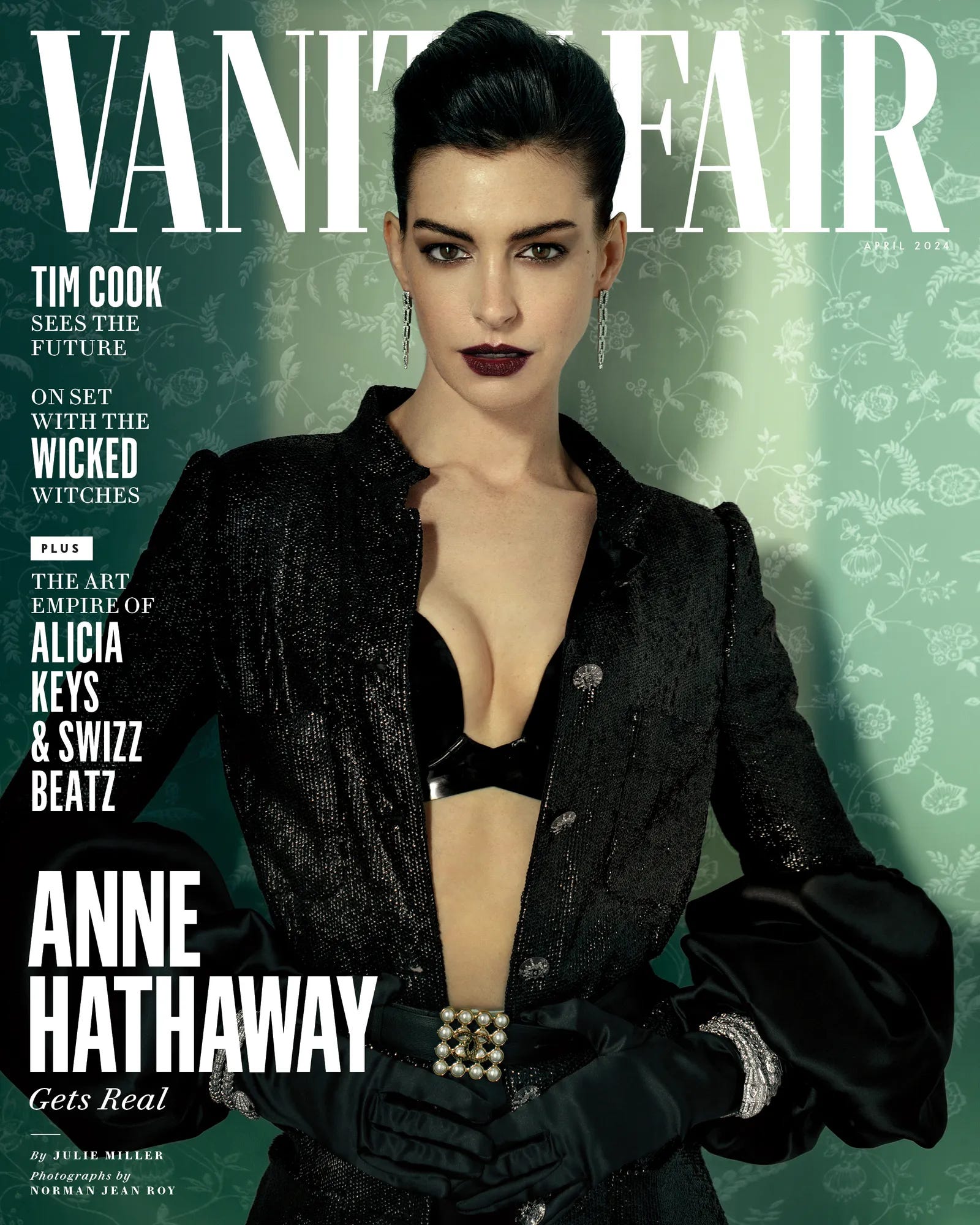
In a 2024 Vanity Fair interview she explained:
“A lot of people wouldn’t give me roles because they were so concerned about how toxic my identity had become online. I had an angel in Christopher Nolan, who did not care about that and gave me one of the most beautiful roles I’ve had in one of the best films that I’ve been a part of. I don’t know if he knew that he was backing me at the time, but it had that effect. And my career did not lose momentum the way it could have if he hadn’t backed me.”
Hathaway is referring to Nolan casting her in Interstellar. That was the second time Nolan cast her in a project, the first was The Dark Knight Rises in 2012, and their latest was The Odyssey this year.
In an appearance on The Ellen Show in November of 2014, Hathaway discussed the experience:
“I listened at first. I couldn’t help it. You try to shut it off and I couldn’t. And then I realised why I couldn’t was I hadn’t learnt to love myself yet, I hadn’t gotten there. And if you don’t love yourself when someone else says horrible things to you, apart of you is always going to believe them. So then I was like OK. I don’t want to believe these people, I don’t want to agree with them on any level. I’m going to figure out who I am, I want to learn who I am.”
Hathaway took a short break and before appearing in Ocean’s 8 in 2018, then Hustle in 2019, and We Crashed in 2022 and has been on a steady upward trajectory, helped enormously by her style evolution, ever since ombreing from Hathahate into Hathaslay.
The Price of Fame
Why does this matter? Hathaway’s journey as an actress isn’t unique one can argue. Many celebrity women have been fed to the cyber wolves and the salivating clicks of the paparazzi, before, after or while being hailed as an icon of their generation. Hello, Lauren Hill said it best in Superstar:
“They’ll hail you then nail you, no matter who you are, They’ll make you now then take you down.”
She is a public facing person and so the argument there is that she has no choice on when and how her image and story is used in public discourse.
While some celebrities, particularly in reality TV, relish a viral moment that could propel or enhance their career, even going as far as to clip farm themselves while on camera in the hopes of being memeified, some famous people aren’t interested in becoming the butt of a joke.
Is this allowed? Sorry another rhetorical question.
And while we can take the Ricky Gervais route of:
“Let’s get this in perspective: They’re the wealthiest, most privileged people in the world. Offence is taken, not given. It’s your choice.”
A perspective that was shared long before by Joan Rivers when speaking about her show Fashion Police she said:
“The key is let’s not take it so seriously. It’s people walking around on red carpets and they’re all making millions of dollars. You can take a little flack.”
It’s a line of thinking the public gets behind, one that can create a path which smashes through blind celebrity worship.
But at some point, a celebrity’s personhood can’t completely be up for consumption. In bursts, waves, or cycles, fame functions now like an affliction. The more famous someone is the less honesty they are, the less human we perceive them.
Even now, in the midst of the public inhaling Hathaway like she’s the last oxygen mask in a nuclear fallout there is extreme conspiracy theory ridden disapproval of her, her body, her intentions.
Hatha-hate Never Really Left
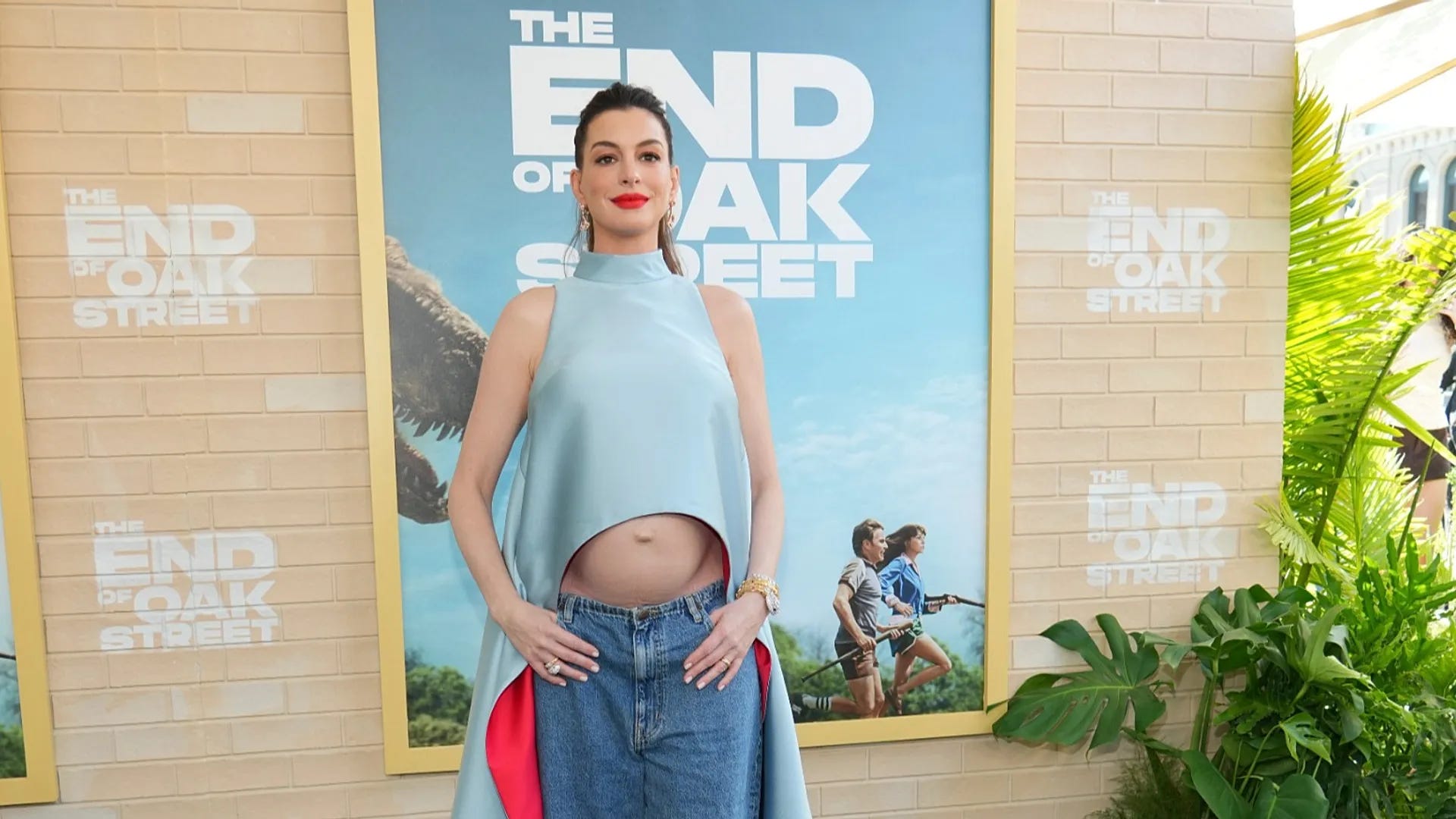
At the world premiere of The End of Oak Street last week, Hathaway showed off her bare baby bump in a silk crop top and low-rise jeans. The bump, from what I gather, looks exceptionally ideal as far pregnancy bumps go.
This seemed to have sparked a lot of questions and outrage, and like a storyline from Desperate Housewives, rumours began circulating that Hathaway’s bump and her whole pregnancy were fake.
I’d like to point out the obvious here. If one was indeed faking a pregnancy, I highly doubt they would put themselves in a situation where their prosthetic belly was on full display in front of dozens of cameras.
Hathahate may have dulled but it never completely left.
The rumours were addressed by Hathaway through a video recap of the red-carpet event on Instagram along with a simple caption: “Fake hair, real bump.”

It feels like Hathaway has learnt who she is, as she described was her priority in that Ellen interview over ten years ago. I also understand that for her part, this is a strategy, an act, another phase of the public persona that she has had to cultivate since the days of Hathahate.
The question here shouldn’t be how “genuine” is it and how “authentic” she is, but more what personas Hathaway and other female celebrates have to inhabit in order to navigate the land mine of public life on the internet. Part of that is talking about her favourite memes of herself - whether the intention is to explain, laugh about, or stay afloat of the conversation.
It was pointed out to me in a conversation with a friend on this topic that there was a chance that Hathaway, who is probably media trained within an inch of her life, chose those two memes on purpose. She wanted to explain away toe of most unglamorous images of her.
Probably, potentially, maybe not. So?
I find the argument that any person, particularly a woman, using every arsenal at her disposal to control her public image a thing by which we should judge her, seeped in some misogyny. The fact that she was hated for no reason, when many men have performed atrocities and have been forgiven, is in fact the problem here.
Not every woman can be a chilled-out gal and not care what others think of her. It’s human. I don’t have enough time to go through the list of women who have had to go in hiding under strict, maniacal measures to control their public personas as a means to protect their humanity.
OK, I have a little time – Jennifer Lopez, Meghan Markle, Taylor Swift, Victoria Beckham to name a few.
We Are All Always Watching
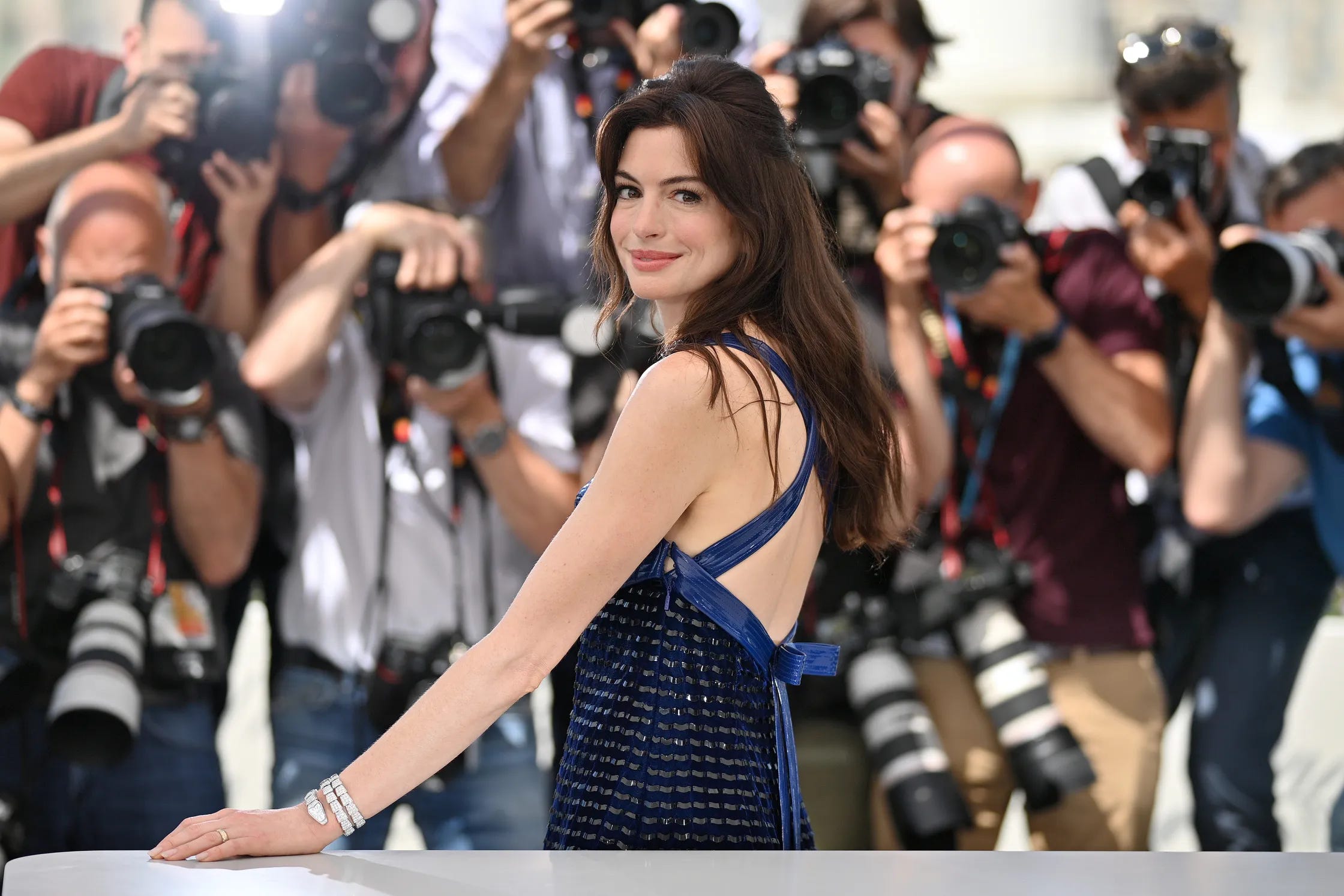
Beyond Hathaway, the boundary blurs between how we interact and use celebrities more every day. Every refresh of the algorithms, every update of newsfeeds, every new AI invention, affords us more intimate ways to watch celebrities across their work and to speculate on their personal lives. In turn, the parasocial relationship intensifies.
I won’t go into the invasion of privacy the paparazzi committed while photographing Hathaway without her consent in cupcake meme. It goes generally without saying that if it were up to Hathaway she most likely would have preferred not to have been photographed scoffing down a cupcake. Conversations on paparazzi tabloid culture unfortunately seems less pertinent these days especially when we AI glasses are rapidly invading people’s privacy celebrity or not.
It’s nauseating to think about how much access and entitlement we have to how famous people exist, regardless of if they are welcoming us into their lives or not.
It allows for the parasocial to mutate out of the petri dish and metastasise, engulfing culture in a relentless all-consuming grip. The effects of the cycle of loathing and loving, hating and hailing can not only be detrimental to a celebrity on an individual level but also to us as a culture.
Even if you think the world of celebrity somehow exists in a parallel universe, a place of fiction, it’s ignorant to assume it doesn’t affect us on a granule level. Even the happenings of the Gods on mount Olympus influenced the lives of mortals.
This to me is one of the reasons why the close observation, study, and critique of pop culture is crucial. Through that lens, from meme to headline, to red carpet interview and fan led movements, an Instagram caption and thousands of comments, patterns emerge in pop culture. Connecting them paints a moving portrait of how we interact with the world and each other.
I am not disconnected or above the cultural zeitgeist movements or vehicles of the moment. Memes bring me a lot of joy.
There is no obvious answer or remedy to me here no one particular individual or group to blame. But there is the inherited systems and our own tribal instincts that we should always be questioning.
There is also irony. I can’t help but think about it.
We had one of the world’s most famous women disguising her panic attack on a reality show that explores alter egos, constructed personas, and the relationship between a performer and the characters they conjure. It was a smile “that didn’t reach the eyes” that became one of the most widely shared memes in recent history, that says so much and yet not enough about who we are.
Here’s one thing that I find sad about Hathaway’s Oscar acceptance speech. It was the last line, hopeful, naive and feels a bit sad.
“Here’s hoping that someday in the not-too-distant future, the misfortunes of Fantine will only be found in stories and never more in real life.”
I by no means want to compare the tragedy of Fantine life from Victor Hugo’s Les Miserables to that of the issues that affect celebrity lives. But it must be said that the struggles of women, whether in the public eye or not, when it comes to how they should act, disguise themselves, pretend, behave, sounds exhausting.
And I’m afraid there is no chance in the near future that they will only ever exist in stories.