


In June 1951, Harper’s Bazaar unveiled a groundbreaking fashion editorial titled Under the Golden Sun of Egypt.
It featured the iconic model Dovima dressed in ready-to-wear and resort fashion posed against the ancient grandeur of the Giza Plateau, she was photographed by the legendary Richard Avedon.
Under the Golden Sun of Egypt, photographed on location, is widely credited as the first major fashion editorial to pair contemporary Western attire with authentic ancient Egyptian landmarks. The editorial marked a pivotal moment for fashion photography.
Predecessors, from Egyptian-inspired 1920s fashion illustrations to Hollywood epics, relied on studio sets or fantasy but none had ventured into on-location couture editorials in Egypt.
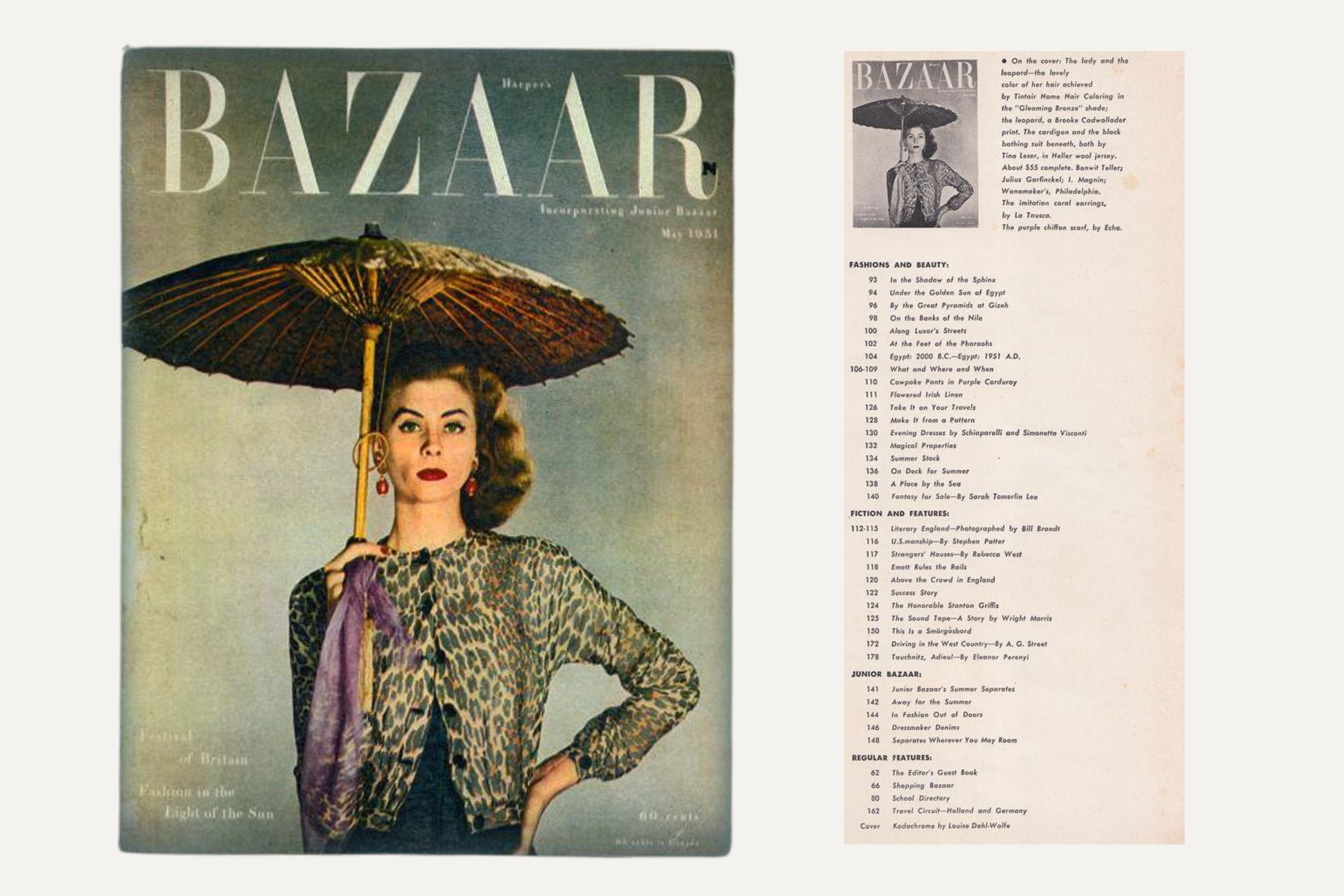
Avedon broke new ground by placing modern American fashion, draped on Dovima, against the monumental backdrops of Giza’s pyramids and Luxor’s ancient ruins.
Th editorial is more than a powerful visual story. It signaled a shift toward realism, narrative, and sense of place, repositioning fashion photography as high visual artistry.
Under the Golden Sun of Egypt also tapped into visual tropes that have long shaped western ideas about Egypt and the Middle East.
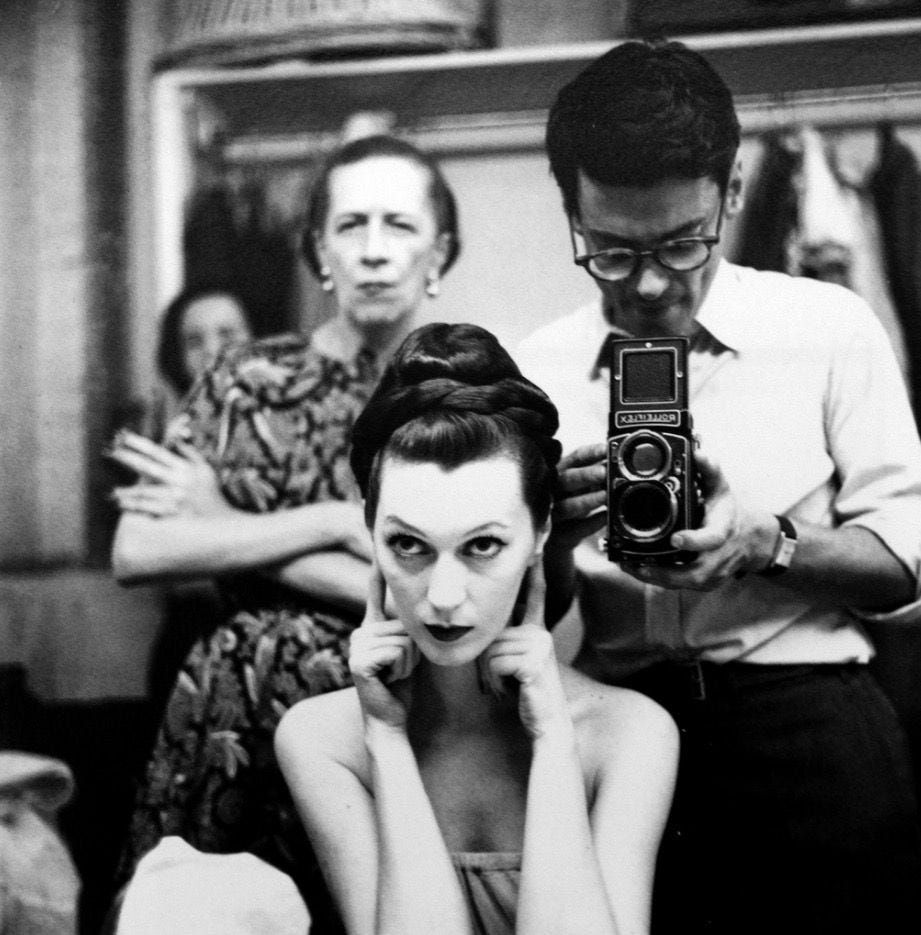
Central to the editorial’s vision was fashion editor and columnist Diana Vreeland, who was then the fashion editor at Harper’s Bazaar before moving on to Vogue. She had an editorial vision to showcase American ready-to-wear against the grandeur of Egyptian antiquity, deliberately contrasting modern practicality with timeless monuments.
Vreeland’s was enthralled by the “East” an interest that was less political or anthropological and more visual and theatrical. She cultivated fantasies of exoticism that valued sensuality and spectacle over cultural accuracy.
Vreeland’s influence on the Egypt shoot is encapsulated in what she reportedly briefed Avedon in a memo.
Diana Vreeland writes, “Dick, before you plan these pictures, just think about Cleopatra. Think about those hot nights… she’s walking on the roof, everybody is so old and she’s this young, beautiful girl pacing that roof.”
Avedon was already creating work in this frame of thought. He gave the medium narrative weight by debuting modern settings and emotional nuance. Instead of styling models in sterile studios, he placed them in the real world – realised in grand and glamorous settings.
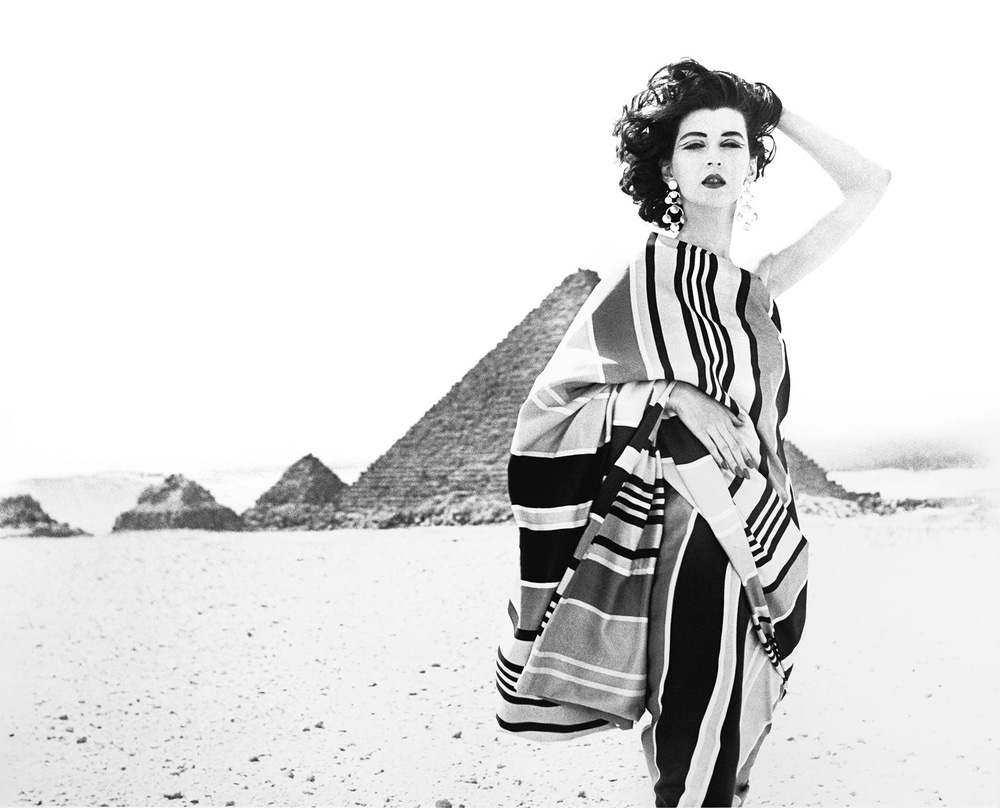
In Under the Golden Sun of Egypt, Dovima appears in elegant, modern couture amid the pyramids and the enigmatic Sphinx. It was a daring vision that defied editorial conventions.
The editorial was full of vitality and narrative, qualities that critics previously claimed fashion photography lacked amid stiffness and its commercial intent. Avedon’s transformed fashion photography with a revolutionary visual language.
In Schirn Museum’s 2014 exhibition, Paparazzi! Photographers, Stars and Artists the accompanying essay, Utmost Authenticity: Richard Avedon noted that shooting “in front of the pyramids in Giza” was emblematic of his commitment to spontaneity and emotional truth in fashion imagery.
“Photo shoots took place … on boats and in front of the pyramids in Giza. He took pictures of his models applying lipstick, in conversation, or with their eyes slightly glazed over … The situations come across as natural, taken from life, accidental. And yet they are unsurpassably elegant.”
From zoos to circuses, Avedon famously removed models from controlled environments, favoring real-world, larger than life locations that added cinematic drama and storytelling depth to his photographs and fashion editorials.
At the centre stood Dovima, one of the 1950s’ most iconic models, renowned for her poise and magnetic presence.
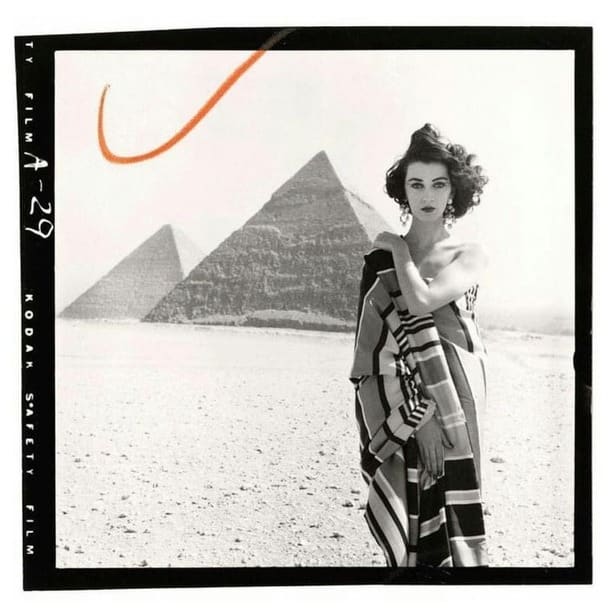
Her creative synergy with Avedon was legendary. He described their partnership as being “like mental Siamese twins,” anticipating each other’s moves to create images that transcended a mere display of clothes.
Dovima was more than a popular model, she was a muse and collaborator in fashion’s evolution from static posing to dynamic performance.
In the 1958 New Yorker article A Woman Entering a Taxi in the Rain, Winthrop Sargeant described Avedon’s evolving fashion style which includes Dovima’s revealing comment on the East.
The article recounts:
When she returned to the United States, a friend asked how she had liked Africa. Dovima replied:
“I didn’t get to Africa... but I was in Egypt.”
The friend pointed out that Egypt is in Africa.
“It is?” Dovima said. “Good Lord - if I’d known I was going to Africa, I’d have charged double.”
Dovima’s bemused response captured a broader cultural unawareness of Egypt, and the Middle East at large.
In the 1950s, most Americans had only the vaguest understanding of Egypt or the Middle East.
This limited perception was shaped by powerful cultural filters. It began with orientalist painters such as Jean-Léon Gérôme or Charles Wilda whose meticulous and idealised canvases staged Egypt and the East as an exotic theatre of colour, light, and mystery.
By the mid-20th century, geopolitical headlines were reinforcing that imagination. Reports on the Suez Canal’s strategic value, the rise of nationalist leaders such as Gamal Abdel Nasser, and the upheaval of the 1952 revolution cast the country as politically volatile.
Layered onto top were Hollywood spectacles like Michael Curtiz’s The Egyptian, along with glossy travel features, archaeological “discoveries,” and museum exhibitions that froze Egypt in time. For many in the West, the result was a fragmented understanding, less about less about modern Egypt’s lived reality than about a curated fantasy of romance and upheaval.
Under the Golden Sun of Egypt fused luxury and ancient history, portraying Egypt as an alluring, timeless realm of mystery and grandeur. Yes, that imagery perpetuates orientalist fantasies – favouring spectacle over cultural authenticity. But fashion editorials are not documentaries. They aren’t supposed to tell the truth as its lived, but an emotional truth seeped in fantasy and glamour.
These images endure as works of art. As when Harper’s Bazaar originally presented them, they continue to enchant with elegance and epic scale. While they have informed the language of orientalism, they remain dreams, not documents: visually breathtaking, cinematic, and historically pivotal in fashion storytelling.
Scroll down and have a closer look at the images of this incredible collaboration which includes some of the original captions published in Harper’s Bazaar, June 1951.
In his 1958 New Yorker profile, Winthrop Sargeant recounted how Dovima seemed swept up in the grandeur of Giza. Standing before the Sphinx, she insisted the monument was speaking directly to her:
“He is speaking to me,” she told Avedon. “He is saying, ‘Dovima…’”
“How interesting that he should know your name,” Avedon replied.
“He is saying, ‘Dovima, you belong here,’” she concluded, slightly irritated at his interruption.
Sargeant cast the moment as both mystical and theatrical, emblematic of the playful, almost surreal dynamic between Avedon and his muse.
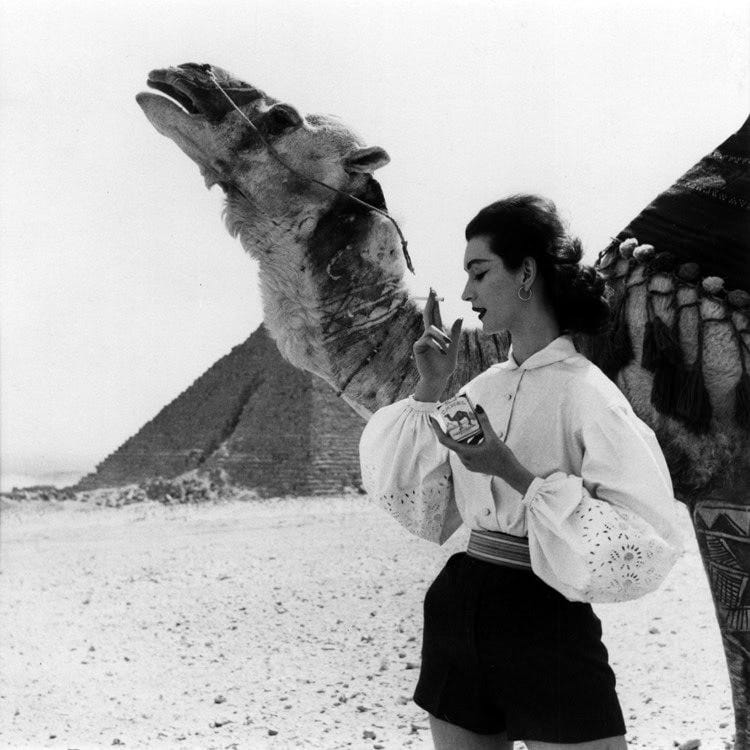
The camel cigarettes facing the viewer echoing the real life camel behind her in a similar pose is a witty nod to art, branding, and the surreal choreography of fashion photography where commerce and culture collapse into one image.
The original caption for this photo published in Harper’s Bazaar read:
By the Great Pyramids at Gizeh
Shirt in satiny white piqué, with puchworked sleeves, about $30; gray Juilliard flannel shorts, about $18. Both, by Arle. Peck and Peck; I Magnin. Monet’s hoop earrings.
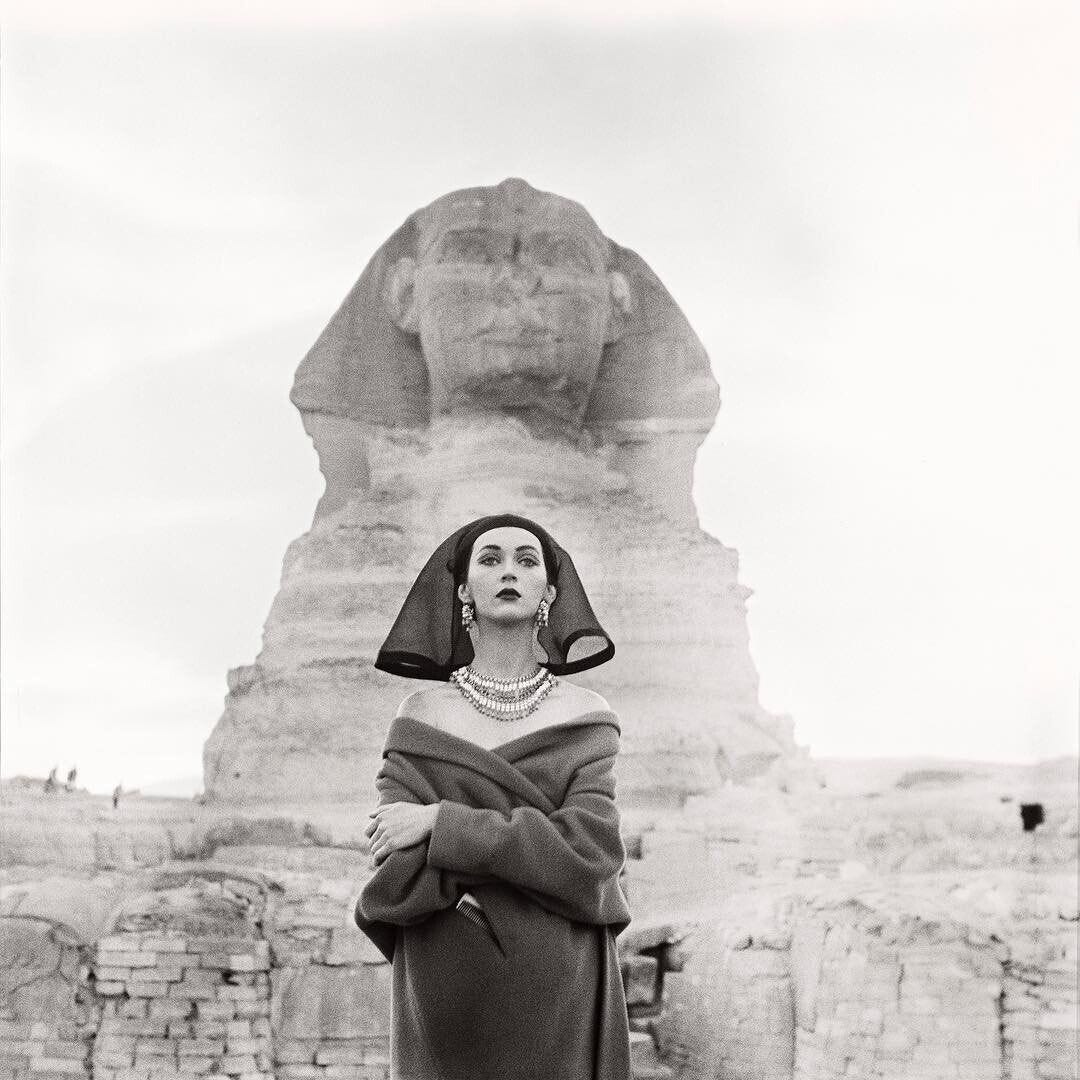
Before the Great Sphinx, Dovima is styled like a modern Nefertiti, her jewels and veil echoing regality against the monument’s eroded gaze. Avedon frames her as an alluring figure with mid-century style, slightly theatrical yet aspirational, set against the oldest icon of permanence.
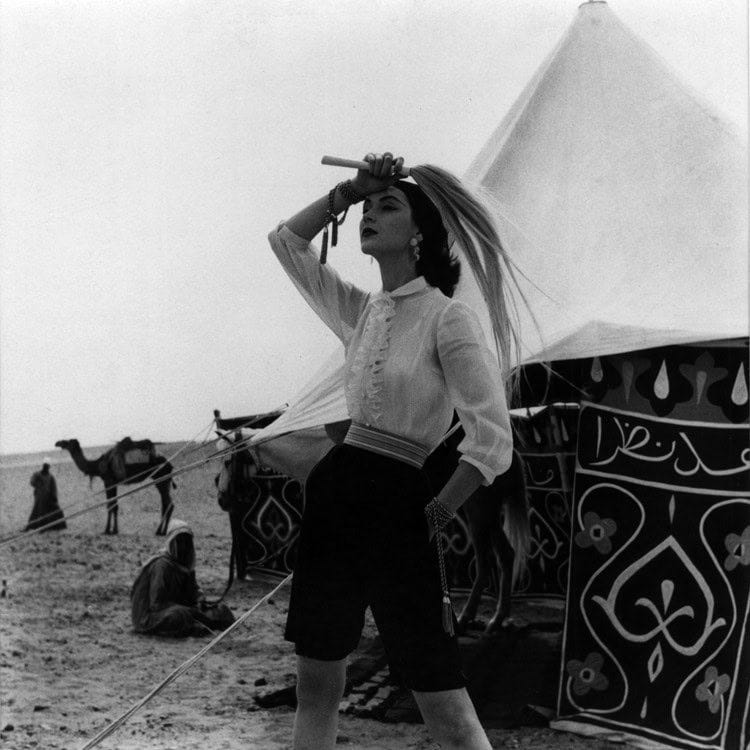
Also according to Sargeant’s article, the shoot takes place during Avedon’s honeymoon with his second wife, Evelyn. So it was most likely that Evelyn and Dovima’s husband, Jack Golden, who generally accompanied her on location shoots, were both present. Apparently Golden usually brought along “an armful of comic books” to keep Dovima entertained during shoots.
Original caption:
Shirt in white-on-white organdie; shorts in black Moygashel Irish linen. By Dorothy Cox. $35. Henri Bendel.
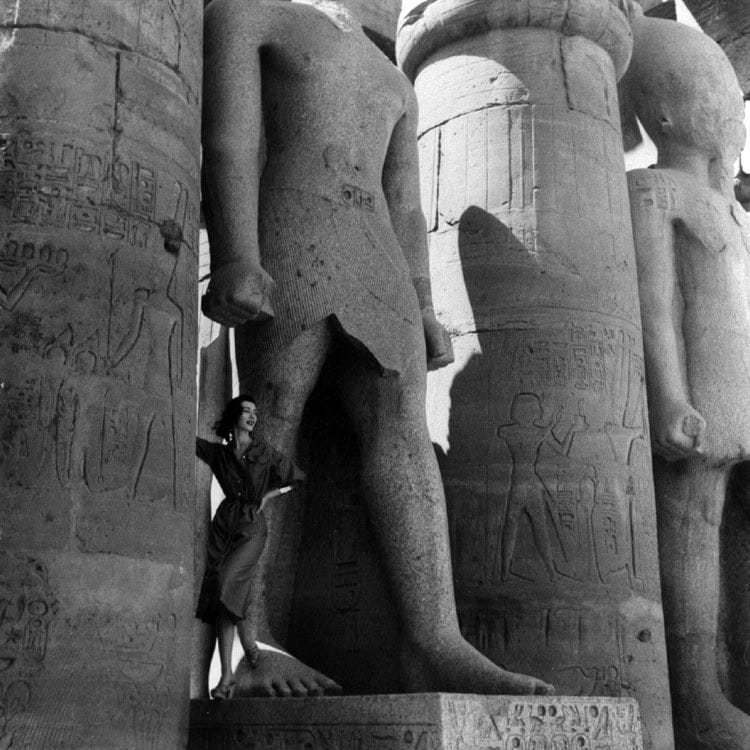
At the feet of colossal pharaohs, Dovima leans into stone as if channeling their immovable power.
Avedon’s composition plays with scale here where the towering statues dwarf Dovima, yet her stance and smile still make her the focus and bring modern vitality into the ancient scene. The photograph combines grandeur and intimacy, making a temple of history feel like an aspirational fashion set.
Original caption:
At the Feet of the Pharaohs
Pale blue polka dots on tan silk taffeta, in a shirt-dress with an elasticized drawstring waist. By Star-Maid. $45. Bergdorf Goodman.
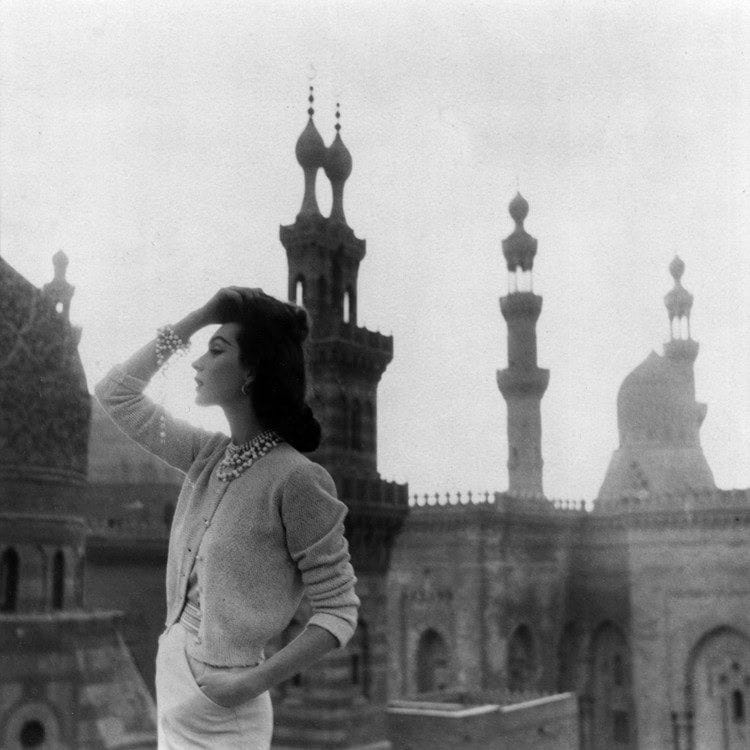
On a Cairo rooftop, Dovima poses against the clustered minarets of what is believed to be the Mosque of Mohammed Ali. The soft cardigan and string of pearls contrast with the jagged skyline, turning a moment of quiet glamour into an architectural study.
Avedon frames Dovima as both visitor and icon, suspended between modern elegance and the city’s historic silhouette.
Original caption:
The smartest and most useful of cardigans – knitted in natural linen yarn. There’s no neater sweater for day, no prettier one for night. By John Miller. About $35. Lord & Taylor; I Magnin. Sandor jewelry. Background: the mosque of Mohammed Ali, the largest and most impressive in Cairo.
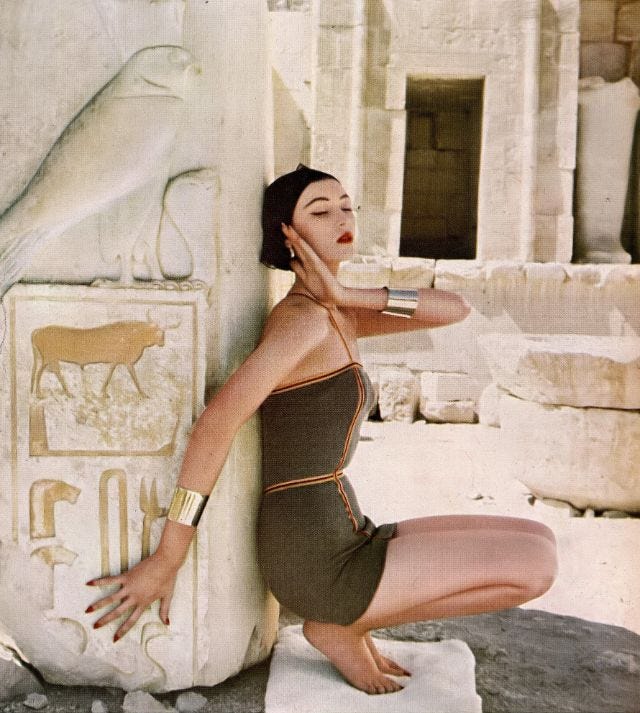
At the Temple of Hatshepsut in Luxor, Dovima folds herself into the geometry of stone reliefs, her swimsuit and cuffs evoking a streamlined modernity that plays knowingly with echoes of antiquity. Avedon’s turns posture into architecture, fusing fashion with the language of Egypt’s ancient architecture monument.
Original caption:
Dovima in suit of elasticized wool jersey by Claire McCardell, photo by Richard Avedon at the Temple of Queen Hatshepsut, Thebes
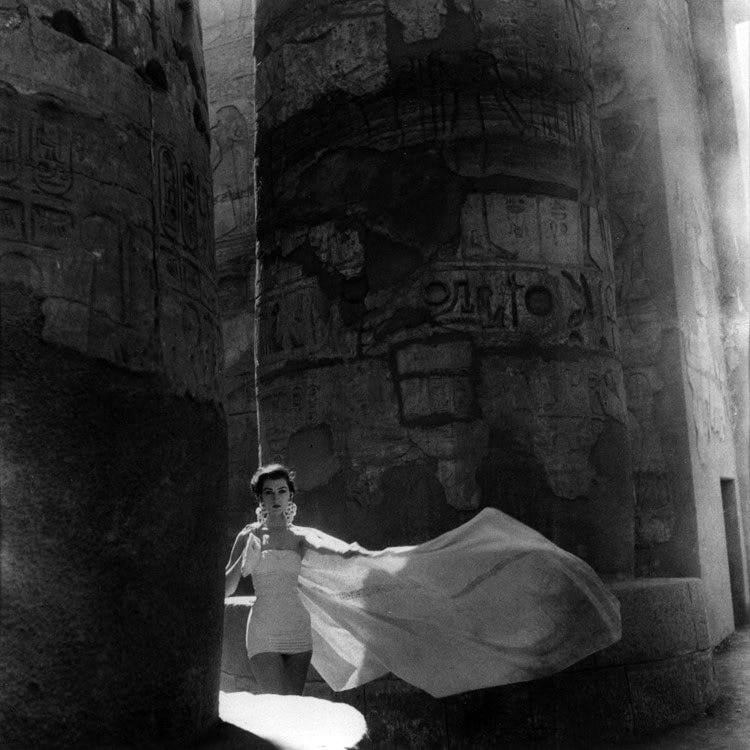
At what is most likely the Temple of Karnak, Dovima appears in her most glamorous, her dress caught mid-sweep like a flash of light against the heavy stone. Avedon staging of Dovima against the carved immensity of the columns, turns contrast into drama, while balancing motion and monument.
Original caption:
Egypt 2000 B.C.
The temple of Karnak at Luxor, almost forty centuries old, its hypostyle hall upheld by more than a hundred columns of carved colored stone. Our model’s swimsuit – shirred white nylon elasticized with Lastex. By Jantzen. $15.95. Best. Martex towel. Vogue earrings.
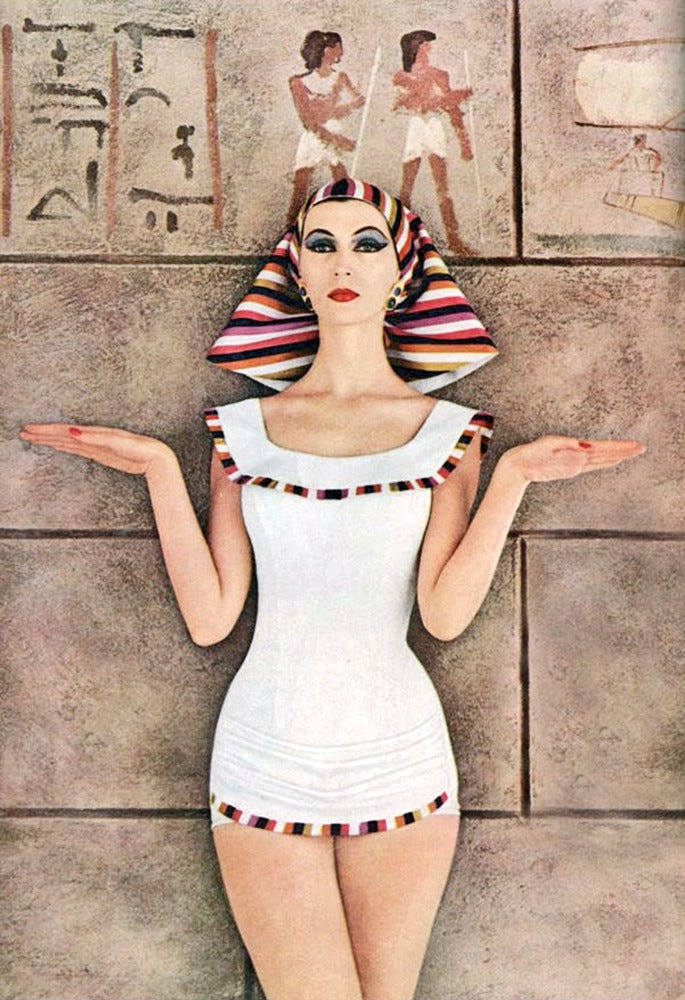
Posing in front of a wall of painted hieroglyphs, Dovima strikes a pose that feels the most choreographed of the series.
Every detail leans toward symmetry from the striped headscarf to the matching trim of the white suit and the outstretched arms recalling both ritual gesture and fashion display. The photo reads as performance, a staged dialogue between antiquity and mid-century modern glamour.
Original caption:
Dovima in a Claire McCardell suit. Photographed by Richard Avedon at the Temple of Queen Hatshepsut, Thebes, Egypt, Harper's Bazaar, June 1951
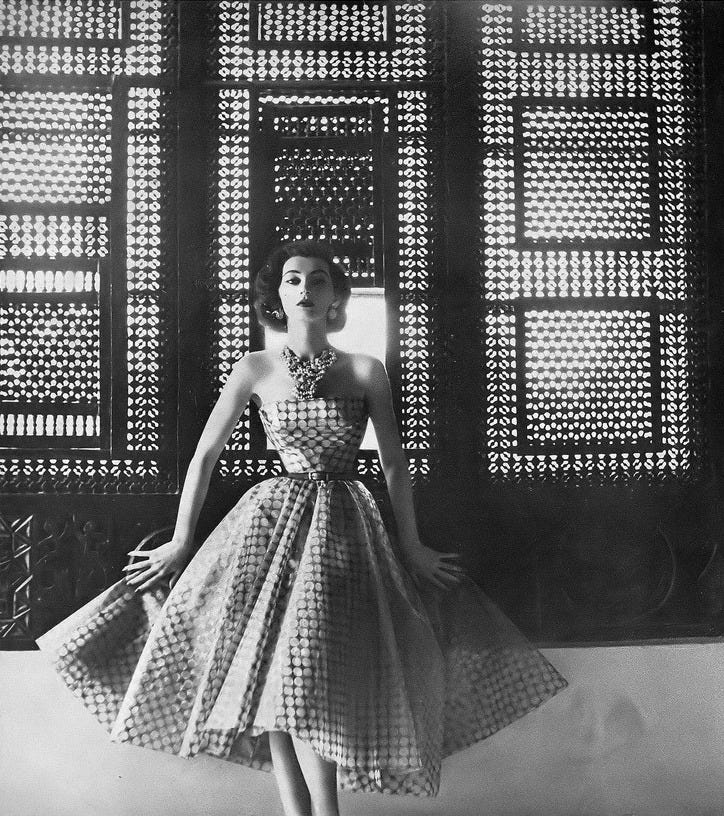
One of the most stunning images from the shoot where the shimmering textile and play of light through the ornate screens against Dovima’s the elegant posture all underscore the theme of merging modern couture with timeless setting
Original caption:
Dovima in white silk organdy dress stamped with coin dots on field of gold by Adele Simpson, photo by Richard Avedon in Mena House near the pyramids of Gizeh, Harper's Bazaar, June 1951
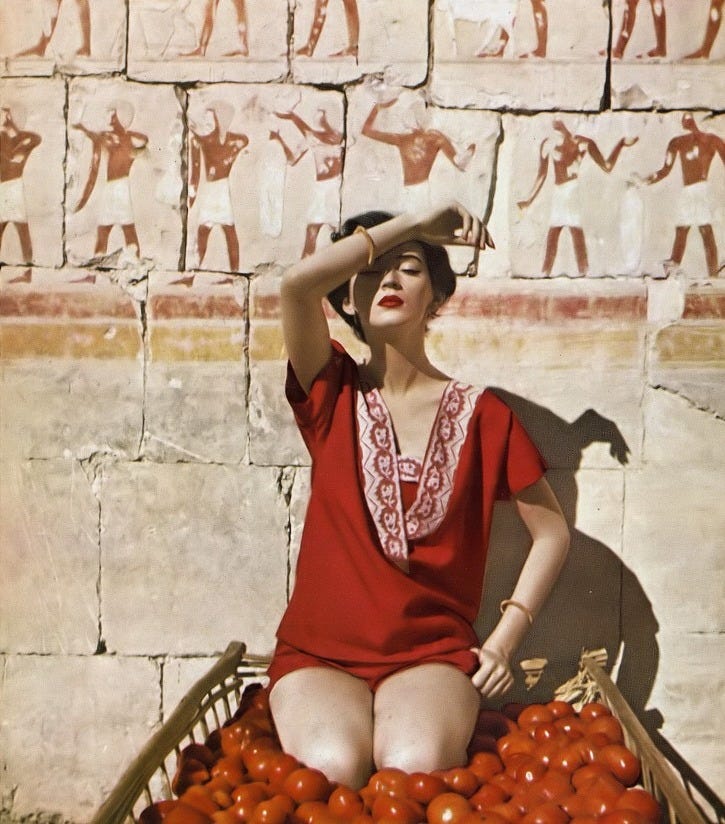
Against the painted reliefs of an ancient wall, Dovima sinks into a basket of tomatoes, her red tunic echoing both fruit and fresco. Avedon layers antiquity with pop vibrancy: the procession of figures above, the saturated color of modern fashion below, and Dovima caught between performance and still pose.
Original caption:
Dovima in linen-rayon cover-up with lace neckline over bathing suit not shown by Carolyn Schnurer, Ektachrome by Richard Avedon at the Temple of Queen Hatshepsut, Thebes, Egypt, Harper's Bazaar, June 1951
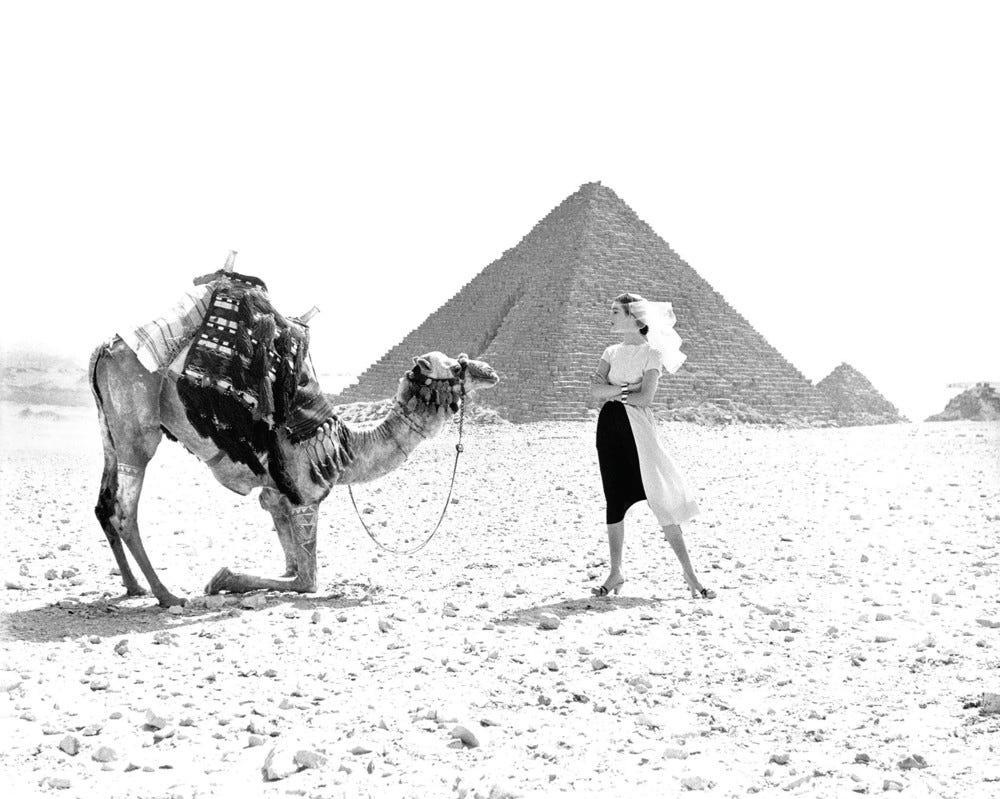
Avedon photograph turns Dovima into both tourist and a monument. She faces the camel as though locked in a quiet duel, her stance echoing the geometry of the pyramid behind her. The camel appears to kneel into submission.
It recalls perhaps Avedon’s interpretation of Vreeland’s brief for the shoot - “just think about Cleopatra… everybody is so old and she’s this young, beautiful girl pacing that roof.”
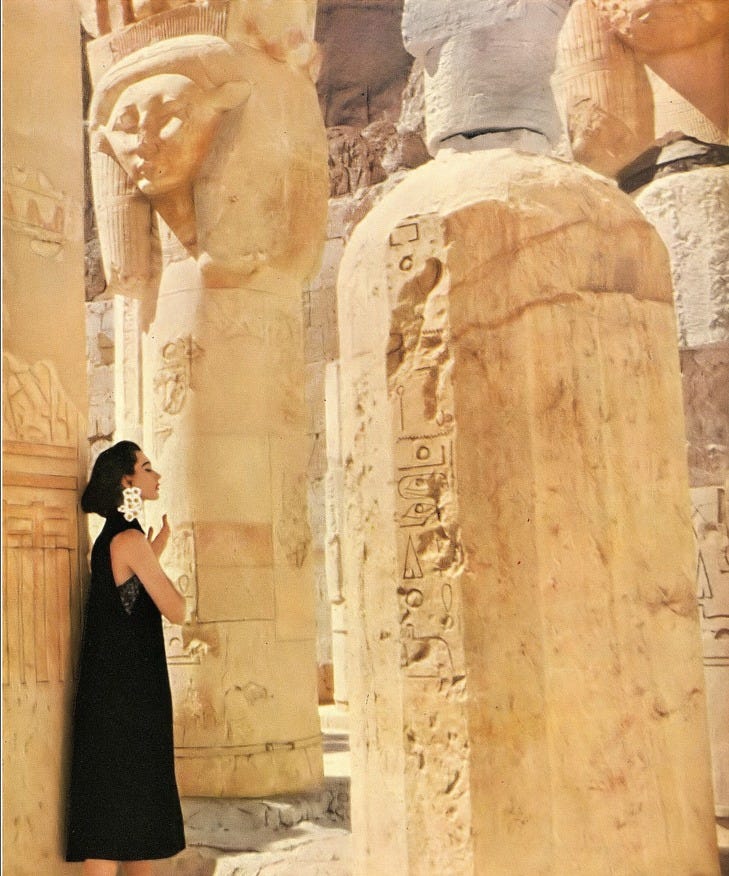
Between the colossal columns of Luxor, Dovima becomes another monument. Avedon’s lens cohesively blends centuries into a single frame: hieroglyphs carved in stone, the modernist line of a black dress, and a pose that reads like ritual. More than seventy years on, the image still feels startlingly modern and timeless.
Original caption:
Dovima in cool sleeveless, Moygashel linen coat by Bonnie Cashin, Ektachrome by Richard Avedon, at the Temple of Queen Hatshepsut, Thebes, Egypt, Harper's Bazaar, June 1951
How does this have no comments? It's stunning.