


It was Valentine’s day last week and love was in the air all weekend.
And whether you and your significant other indulged in a romantic dinner, took a trip or love rotted on the sofa and streamed rom-coms all weekend – did you by any chance think about love and Arab art?
Love is a significant and reoccurring theme in Arab fiction, folklore, poetry, music, and art.
Generally, Arab depictions of love usually lean more toward the melodramatic and tragic – nothing wrong with that per se, we are a people who enjoy adversity in our stories.
But there is also joy in Arab love - romantic, innocent, restrained and always powerful.
Across different styles and time periods, here are my favourite paintings by renowned Arab artists that delve into the various theme of love.
Ballet Dancer by Adham Wanly, 1956
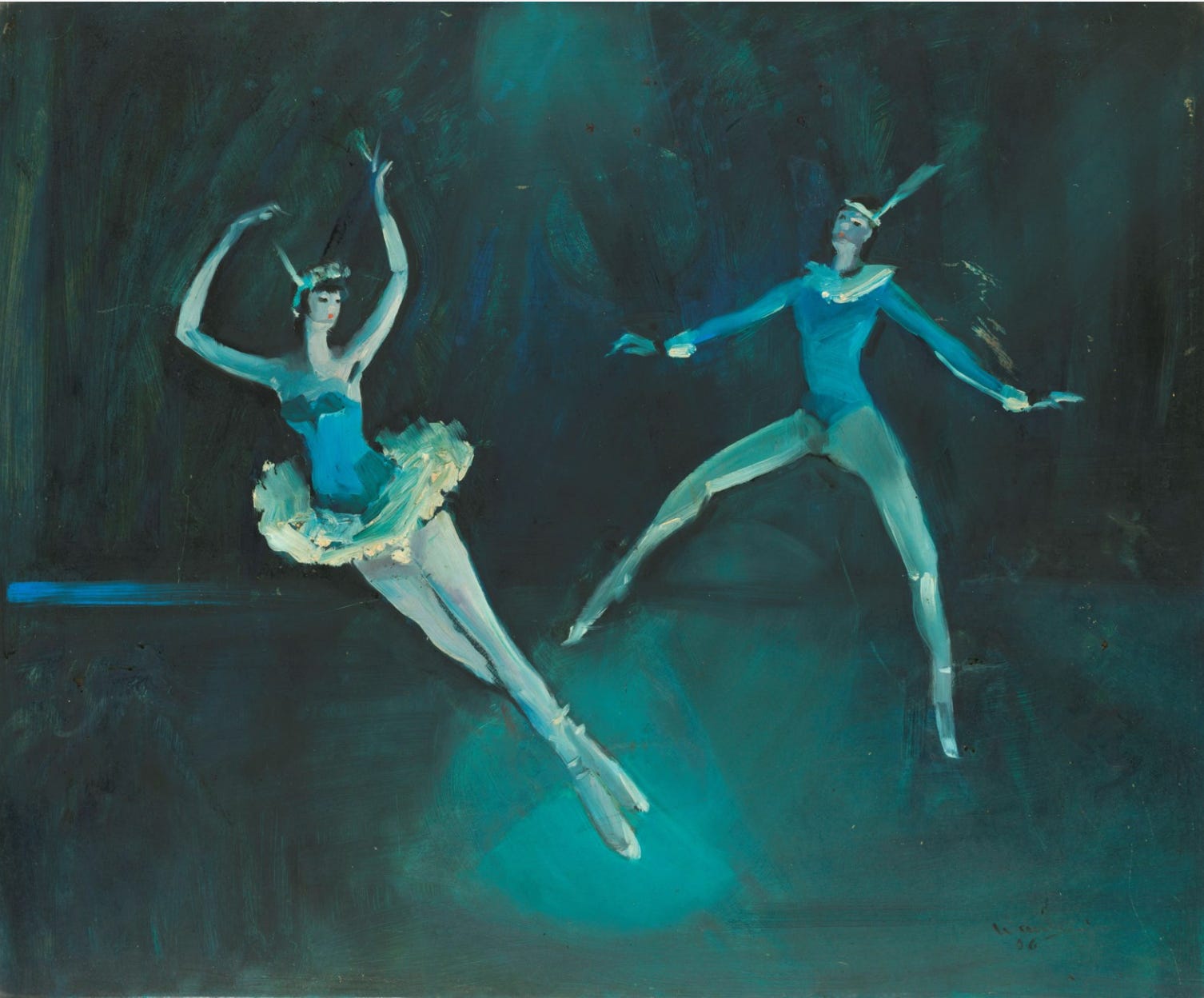
Technically the great Egyptian artist Adham Wanly didn’t depict two lovers in this beautiful painting, but two ballet dancers.
One can only assume the dancers are playing the role of lovers here because the image is oozing with the foreplay and drama of seduction and love.
The way the figures are posed is both elegant but also full of movement. The female dancer looks behind her as she twirls away from the male dancer. Her closed eyes, red pouting lips and the flick of her finger coyly dismiss him, as he looks upon her stunned in mid movement.
Wanly has also emphasised this dynamic between the couple through his stunning use of the colour blue, his quick, expressive brush strokes, the sense of space and the elongated way he’s stylised the figures.
All these elements add to the magical, dreamlike sense of melodrama and performance to the work.
The Kiss by Adham Wanly, 1957
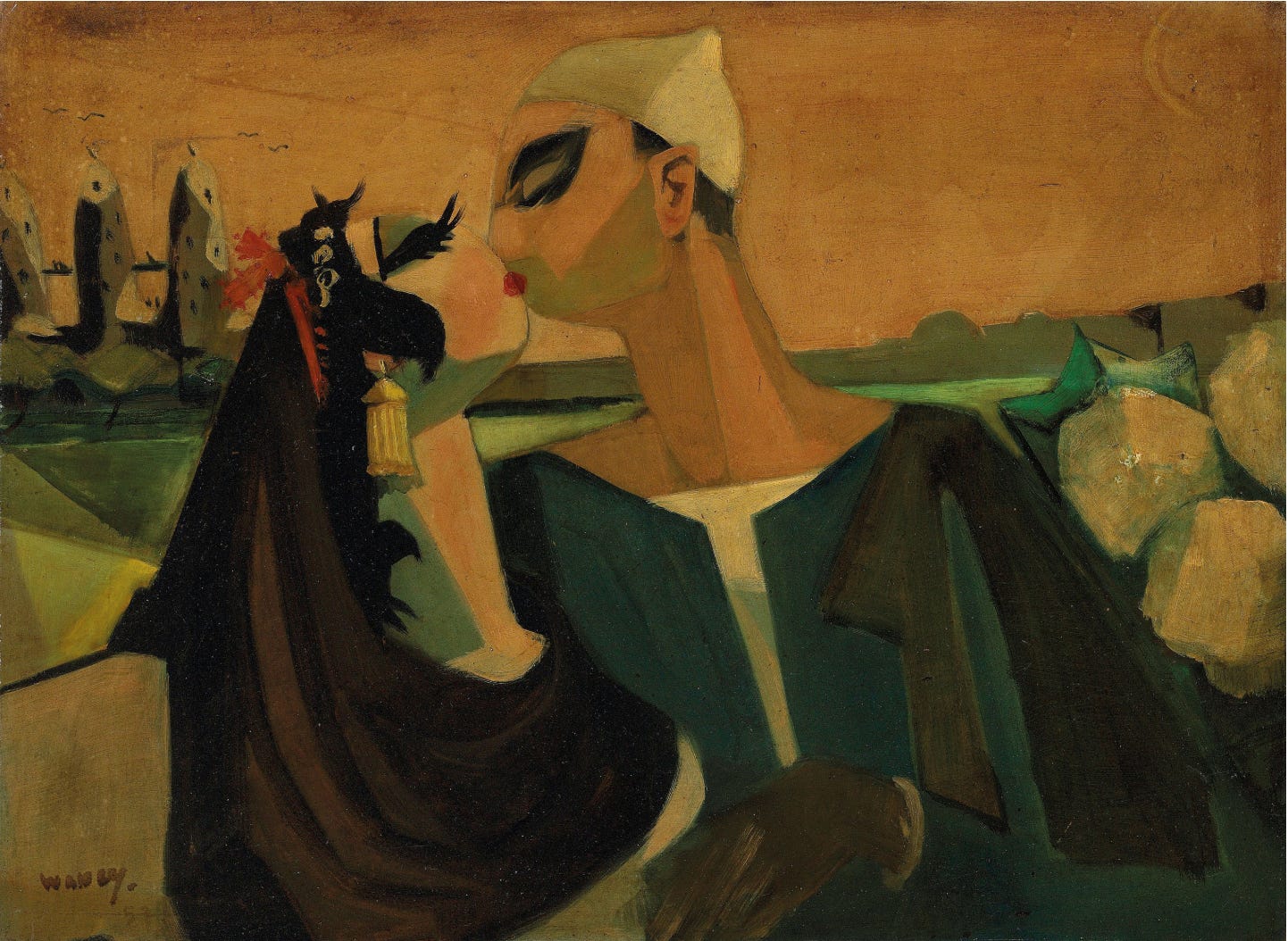
Another stunning work by Wanly, this time of two figures who are definitely a couple.
This is a joyful painting where Wanly has depicted a couple from Egypt’s countryside, dressed in the attire of a fellah and fellaha – colloquial terms which translate to farmers or country people.
They are in an intimate embrace, kissing with their eyes closed, against a view of the Nile valley. The culture of Egypt’s countryside tends to be more conservative, which makes this scene more intriguing and unusual.
Wanly plays with notions of masculine and feminine depictions throughout the work in several ways. This is first seen in the stylisation of the figures – straight sharp lines are used in the clothes, shadows and anatomy of the male figure and softer curved lines for the woman that are echoed in more rounded shapes across the painting,
However, Wanly cleverly connects the couple visually through their features, giving the male figure more feminine touches – particularly through his closed eye - and the woman more masculine ones. While she may be tilting her head up toward him, her neck is painted in a more sturdy, angular manner than her lovers’.
For me, this painting is incredibly patriotic – it’s a story of joy, of humble people of the earth of Egypt celebrating their love for each other.
Qais wa Laila by Mahmoud Hammad, 1960
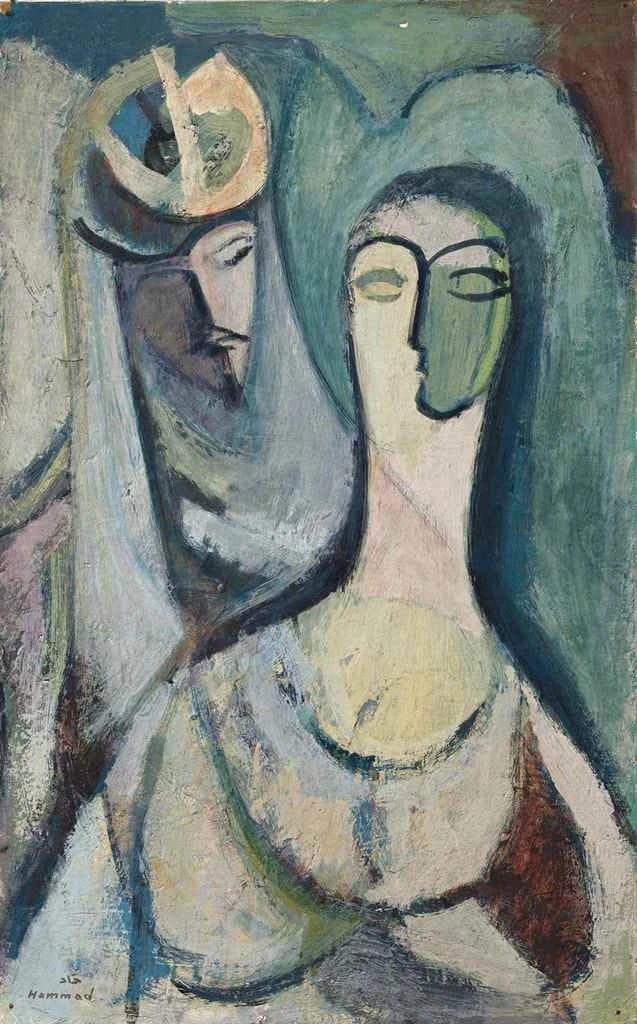
The story of Qais and Laila is a common subject in Arabic literature, poetry, and art.
There are various versions of the tale but the common thread across them follows this timeline of the story.
Qais, a young poet, falls deeply in love with Laila and in his efforts to woo her, expresses his love by composing and reciting poems about her. This leads to him gaining a reputation for being “madly in love” and for her father to forbid their union and then forcing her to marry a noble man.
Distraught Qais becomes so consumed by Laila that he earns the nickname Majnun which translates to madman. He escapes to the desert where he is sometimes seen reciting poetry about Laila.
After her marriage, Laila dies, heartbroken by her separation from Qais.
Qais falls more into madness, and carves verses of poetry on a rock near Laila’s resting place before he also dies heartbroken and alone.
It’s all very tragic and perhaps not completely in line with the joys of love and Valentine’s Day. However, there are many depictions of Qais and Laila that are incredibly beautiful and celebrate, despite ending in sorrow, the power of their love – like Syrian artist, Mahmoud Hammad’s stunning and restrained painting.
Hammad applies a version of western modernisim to the stylisation of the figures particularly in their faces. He blends this concept with more traditional Middle Eastern art particularly in the use of flattened perspectives.
For me it’s the dynamic and intimate composition of how Qais and Laila have been placed in the frame that works so well. In a swirl of exaugurated curved lines and expressive brush strokes, Qais stands behind Laila, watching her or perhaps reciting poetry to her.
She listens while looking ahead at the same time, elongated and fragmented, mirroring the state of their relationship, her feelings or what is to come.
Majnun Laila (Temptation) by Dia Azzawi, 1995
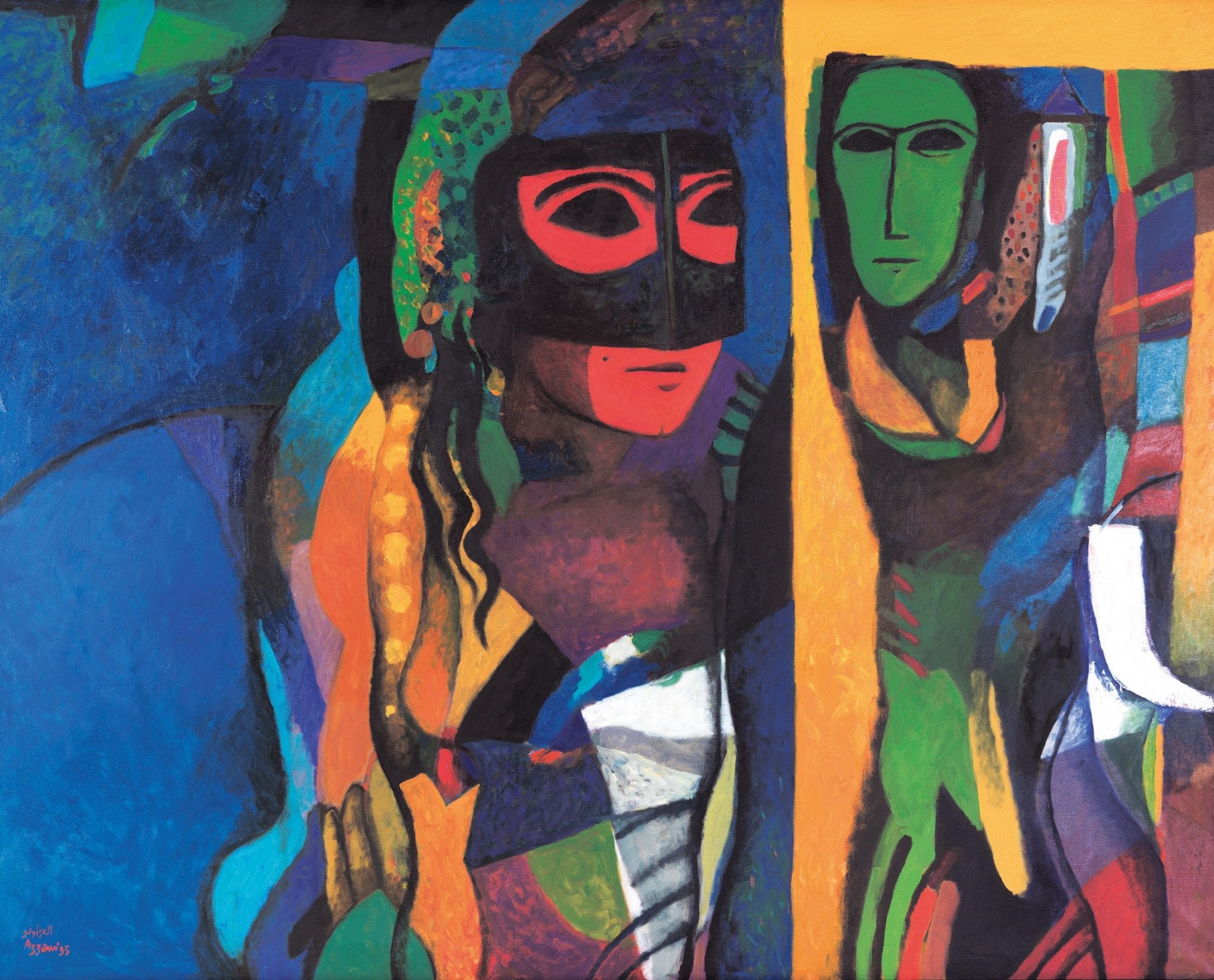
Renowned Iraqi artist Dia Azzawi’s take on Qais and Laila, is equally intriguing but completely different.
Azzawi fused abstract and figurative elements using vibrant, rich colours, and various techniques of layering and shading to evoke a more psychologically intense and emotionally evocative, even slightly erotic aspect of Qais and Laila’s dynamic.
Azzawi has painted Qais and Laila in separate planes, facing each other but with vacant expressions and hollow eyes. Their fluid forms are disjointed, emphasising their physical distance while also pointing out, through the composition of various shapes and the movement within the work, the strength of their emotional bond and their longing for one another.
Interestingly, Laila has been painted much larger than Qais with bold red colour, making her a domineering almost intimidating figure in the work.
This can be read not only symbolic of Laila being a constant muse and source of obsession and inspiration for Qais’ work, but also placing her firmly as the figure in control of this dynamic despite her helpless position in the story.
Untitled by Hussein Bicar, 1996
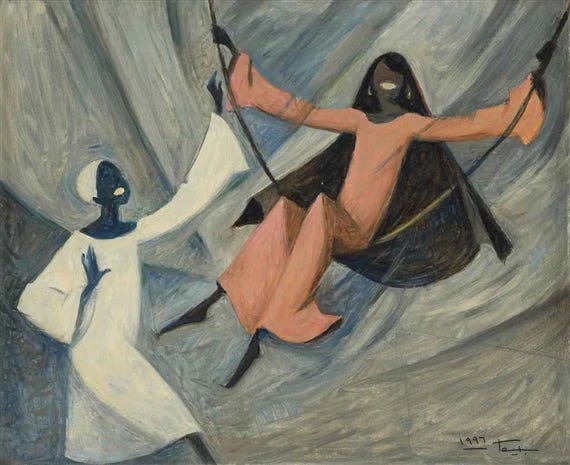
The youthful, innocent facets of love are represented in what I think is one of Egyptian artist Hussein Bicar’s most delightful paintings.
Enjoying a moment together on a swing, the painting is dreamlike and full of carefree movement, as the couple, similarly to Wanly’s from Egypt’s countryside.
The woman is the central focus of the painting, not only because of her higher position in the swing but because her pink dress stands in contrast to the shades of blue and white in the rest of the work. She is both full of joy and in her euphoria, perhaps a little vulnerable though given how high the swing is.
Her partner, stands in front of her, also smiling, though from the position of his hands, he appears slightly weary, careful, waiting to catch her in case she falls off.
The diagonal, curved lines and expressive quick brushstrokes throughout the work only add to the rushed sense of movement and the thrill and elation the couple exude.
Garden of Eden by Suad Al-Attar, 2008
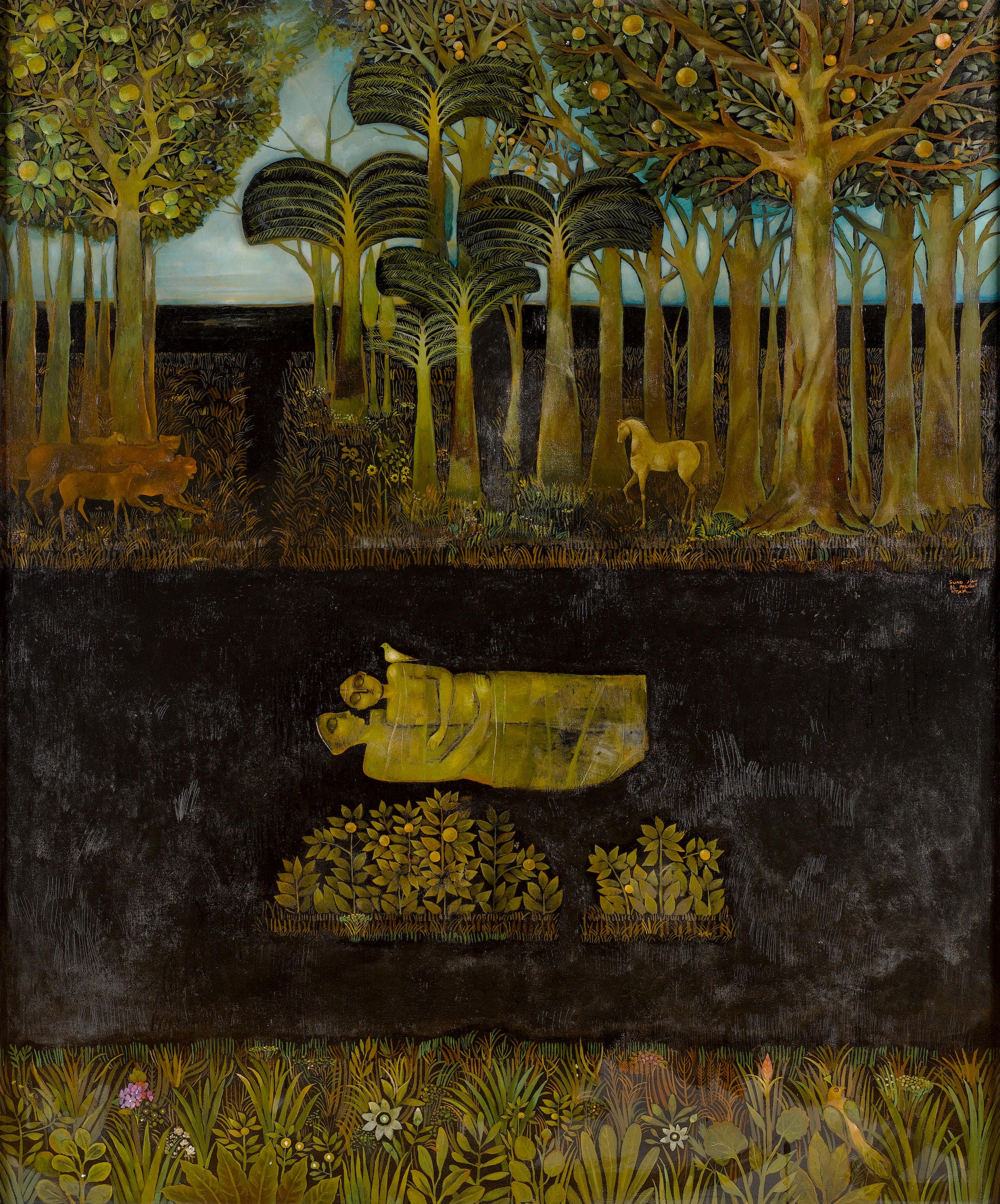
This striking work by one of my favourite Iraqi artists, blends symbolic imagery, cultural and regional heritage, and religious narratives into one painting, whose central theme is romantic love.
Garden of Eden has symbolist and surrealist elements, creating a timeless and evocative image. A lush, atmospheric paradise like garden, filled with stylised and symbolic plat life and animals, is the setting for a couple laying together on a dark field.
The work presents many conflicting concepts – there is innocence and understanding, melancholy and hope, strength and softness, loss and renewal, forbidden desire and romantic love.
The concept of the Garden of Eden by Al-Attar - who is so brilliant at creating expressive and suggestive imagery - is obviously on show here. It simultaneously threads the idea of reclaiming notion of lost paradise and finding solace in nature.
The couple, are not only content and at peace in their embrace, but in their connection to their environment.