


You will stop, you will stare when you see one of Alymamah Rashed’s paintings. Surreal, captivating, detailed and with a feeling of spiritual expanse, Rashed creates works that explore the story of the body.
Connecting the personal to the universal, these stories sit on the intersections of identity, memory and how the natural word blooms, seeps, weaves into the realities of being human.
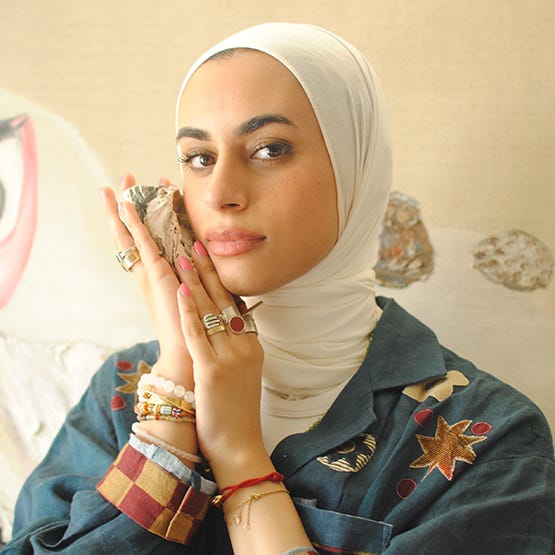
Womanhood is the facet through which the Kuwaiti artist sifts through regional folklore, floral and botanical growth, and the beauty of the banal, the every day. Merging Eastern and Western perspectives, Rashed takes all these elements channeling them into each to create arresting, dreamlike imagery that feels as intuitively present as they are when she was creating them.
Aside from exhibiting internationally, Rashed’s unique aesthetic has caught the eyes of lucury brands including Dior and Piaget of which she was collaborated with.
In this week’s of Great Big Questions, Rashed tells The Culturelist how “every work begins with a seed of intention,” why she doesn’t really believe in distractions, and what being “stuck” during the process of making art can really mean for an artist.
What’s easier for you: starting a project or finishing one?
It isn’t really a question of whether starting or finishing is easier. Each stage is rewarding in its own way.
Beginning a work feels like planting the first seed and breathing its first spirit into existence. It is a space of intention, but also one of chance, surprise, and discovery. The seed is the seed of intention, yet what grows from it often exceeds what I could have imagined at the start.
Finishing a work is about gathering all of those planted seeds and witnessing the forest they have become. It is a moment of arrival, where I can reflect on the conscious and subconscious decisions that shaped the work along the way. In many ways, completion is an act of understanding how those two forces met each other to create something larger than either one alone.
How do you know when a work is done?
I know a work is complete when I feel that I have reached a destination of fulfilment. It is a deeply intuitive feeling, one of arriving at the place I intended to reach or sometimes blooming into something beyond what I originally imagined.
Completion is not necessarily about resolving every detail but about recognizing a sense of inner fulfilment and wholeness within the work. There is a particular joy that accompanies that moment, a feeling of arrival. It feels as though the work has found its own home, and in turn, I have arrived at a newly born home within it.
What is your biggest distraction from creating work?
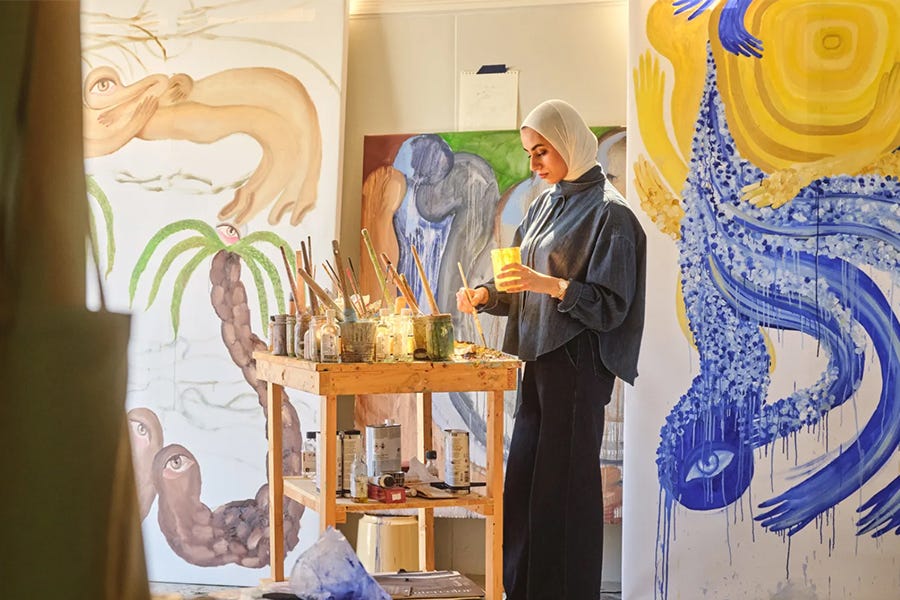
I do not really think of anything as a distraction from my practice. Instead, I believe it is important to allow for moments of pause within the studio.
Often, these pauses take the form of listening to music from my vinyl collection or simply getting up to turn the record over and begin the next side. These small gestures create moments of reflection and breathing space within the process.
I have come to realize that these pauses are not separate from the work itself. They contribute to the final result just as much as the act of painting. The moments between making are often where ideas settle, transform, and find their place. In that sense, every pause becomes part of the journey and ultimately contributes to the work’s arrival.


What do you do when you feel stuck?
I usually see it as a sign that I need to step away from the work for a while. Rather than forcing a resolution, I often begin creating something new and allow the original work to rest.
I return to it when the calling arrives naturally. Over time, I have learned that every artwork has its own lifespan and rhythm. Some unfold quickly, while others require months or even years of reflection and revisiting.
The process is never fixed or concrete, and that is part of its beauty. Each work reveals its own pace, and my role is to listen to it rather than rush it toward completion.
If you could own any artwork in the world, which one would it be and why?
I would probably choose a work by Khalil Gibran. His drawings and paintings are deeply concerned with the relationship between the body and the spirit, how they unite, separate, and continually seek one another. His work captures a profound sense of human fragility, and I find myself returning to that tenderness and vulnerability again and again.
Which creative person would you most like to have dinner with?
I would have loved to have dinner with Etel Adnan. May her soul rest in peace.
I think she is one of the few Arab artists who engaged deeply with the philosophy of beauty and treated it as a serious intellectual and artistic inquiry. Through both her paintings and her poetry, she brought beauty into a critical and thoughtful light. I would have loved to hear her speak about art, landscape, language, and the ways they shape how we move through the world.
Where do you think ideas or creativity come from?
I believe ideas and creativity come from intuition. The challenge is not simply having an idea, but committing to it, trusting a vision enough to bring it into reality.
Creativity requires taking chances, accepting the possibility of failure, and being willing to excavate an image until it reveals itself. For me, every work begins with a seed of intention. No matter how small or humble that seed may seem, it carries a sense of urgency and charge. The creative process is about nurturing that seed and allowing it to grow into something that did not exist before.
What is the best advice you have received about art, creativity, or the process of working?
The best advice I have received is to trust and commit to your intuition.
There is a power and purity in your own voice. Certain images, ideas, and experiences will resonate with you in ways they may not resonate with others, and your role as an artist is to bring those things into the light. The same is true for every artist. We each notice different things, and that diversity of vision is what makes art so vital.
To commit to your intuition is to trust that what moves you is worthy of attention, and to have the courage to follow it wherever it leads
About Great Big Questions
What does it really mean to be an artist? Where do ideas come from? Can creativity be taught? The Culturelist’s artist interview series, Great Big Questions, asks every artist the same eight questions, revealing surprising similarities, striking differences and the deeply personal philosophies behind a life devoted to making art.