


Everyone is talking about Christopher Nolan’s The Odyssey, based of course on the epic poem by Homer. Nolan’s adaptation is on the one hand being hailed as a modern masterpiece of a film and on the other an abomination of the original text.
It’s no surprise that a film of this nature, based on a classic work, would illicit such fevered reactions. People are deeply committed to the “original” story and equally culture hs become, over the last decade or so, deeply devoted to the idea of “accuracy” and “authenticity” when it comes to adaptations and storytelling.
Ironic that the root of the word adaption comes from the Late Latin word adaptationem which means to “to fit” or “to adjust” or to “to join.” In fact, the definition of the word in 1790 was a “modification of a thing to suit new conditions.”
Can we let that simmer in our minds as we actively discuss the adaption of stories?
Now that we’ve taken a moment to do that, considering that The Odyssey is one of the oldest surviving works of literature, composed at around the 7th or 8th century BC, it has been prone to various adaptions over the centuries beginning first of all with art.
I wanted to collate and curate for you some of the first and most interesting depictions of scenes from The Odyssey. These ten works are not only beautiful, created in different styles across eras, but they are also fascinating examples of how the same story, sometimes the same scene, can be depicted and adapted in varying ways to appease or shock audiences while being true illustrations of the artist’s voice and vision.
By the way, Odysseus is the original Greek name of our protagonist, and Ulysses is his Latin name used by the Romans – another adaptation. So often the title of an artwork will include Ulysses when referring to Odysseus.
Penelope and the Suitors Pinturicchio by Pandolfo Pintoricchio (1509)
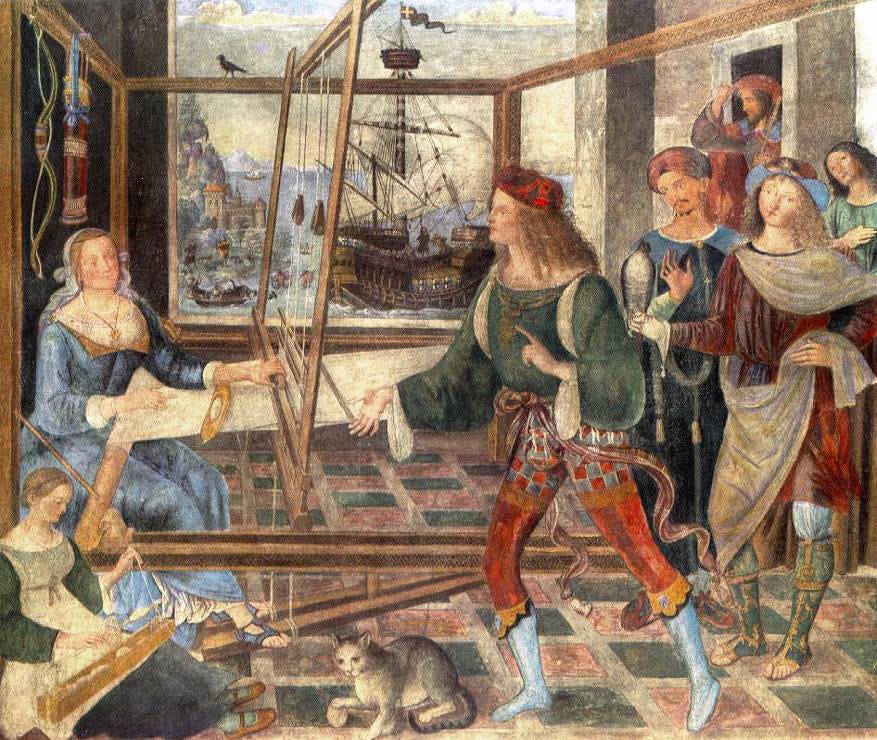
This is one of three paintings in fresco, painted directly on to wet plaster, that once decorated the walls of a room in the ruling family of Siena in Italy, the Petrucci palace. Pandolfo Petrucci commissioned these works to celebrate the marriage of his son to the niece of Pope Pius III and as a way to show off his interest in classical history.
The scene depicts Penelope welcoming (or probably tolerating) suiters while she works on her weaving – a funeral shroud for her father-in-law. It was of course a trick. She told the suiters that she would choose a new husband once she finished the shroud, but every night she would unpick the area she had woven during the day.
Penelope was basically breadcrumbing them to buy herself some time until Odessey’s return.
Perhaps it was a way for Pandolfo Petrucci to signal the expectations he had of his new daughter in law - to be strong, loyal, and steadfast as Penelope is in the story. If I was his daughter in law I wouldn’t put up with art being used as as a passive aggressive vehicle to guide me in my conduct as a wife.
Ulysses and Penelope by Francesco Primaticcio’s (1545)
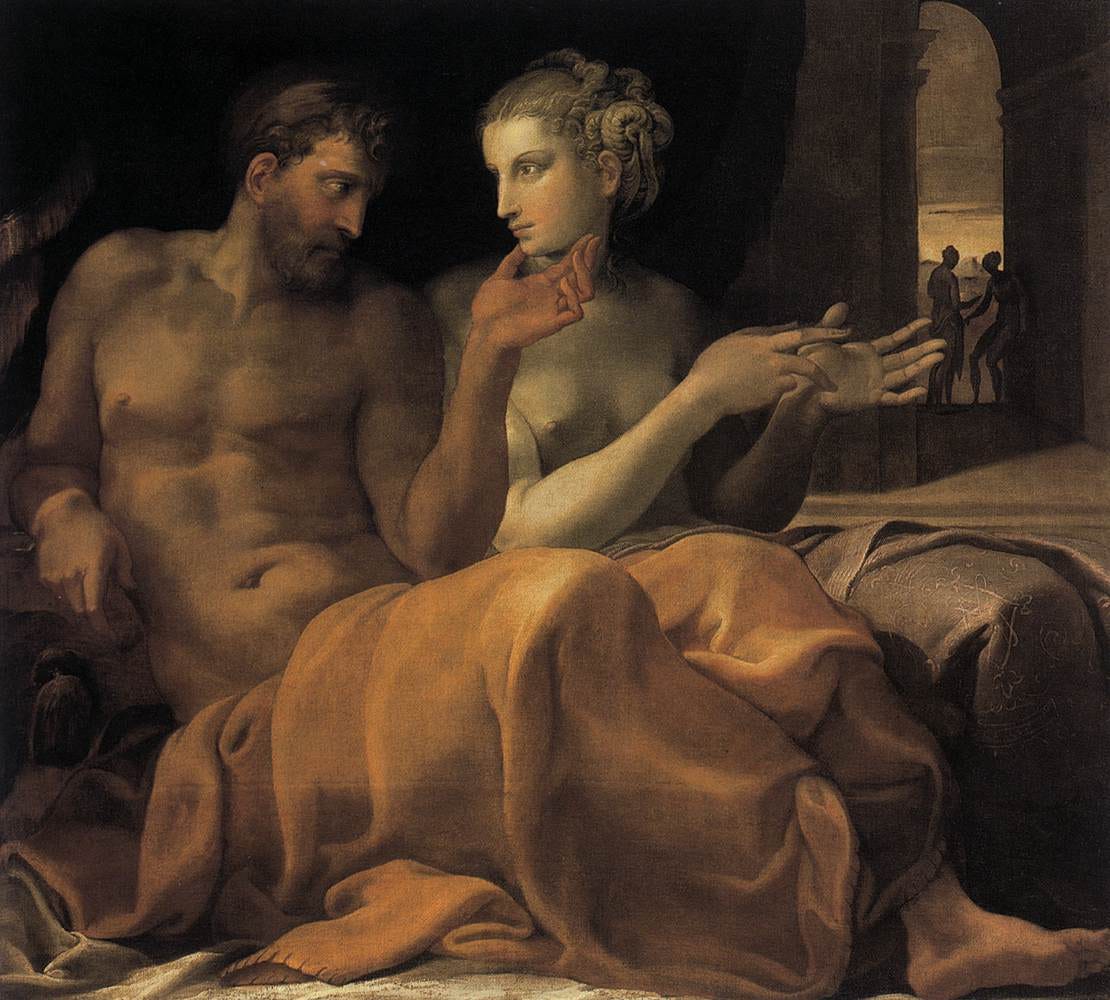
This intimate scene of Odysseus and Penelope doesn’t feel sensual despite them being in the nude. I find his gaze at her while she explains to him what seems to be a strategy or plan (it’s something about her fingers doing a walking motion on her open palm) rather endearing.
I like to think this was the moment in the story where Odysseus is about to tell Penelope that if he doesn’t return that she should take a husband. I found that scene very well executed in the film, particularly Anne Hathaway’s slap across Matt Damon’s face.
The silhouetted figures in the background feel menacing and I wonder if it’s a type of visual foreshadowing of the suitors waiting in the shadows for Penelope to be alone.
Odysseus in the Cave of Polyphemus by Jacob Jordaens (1635)
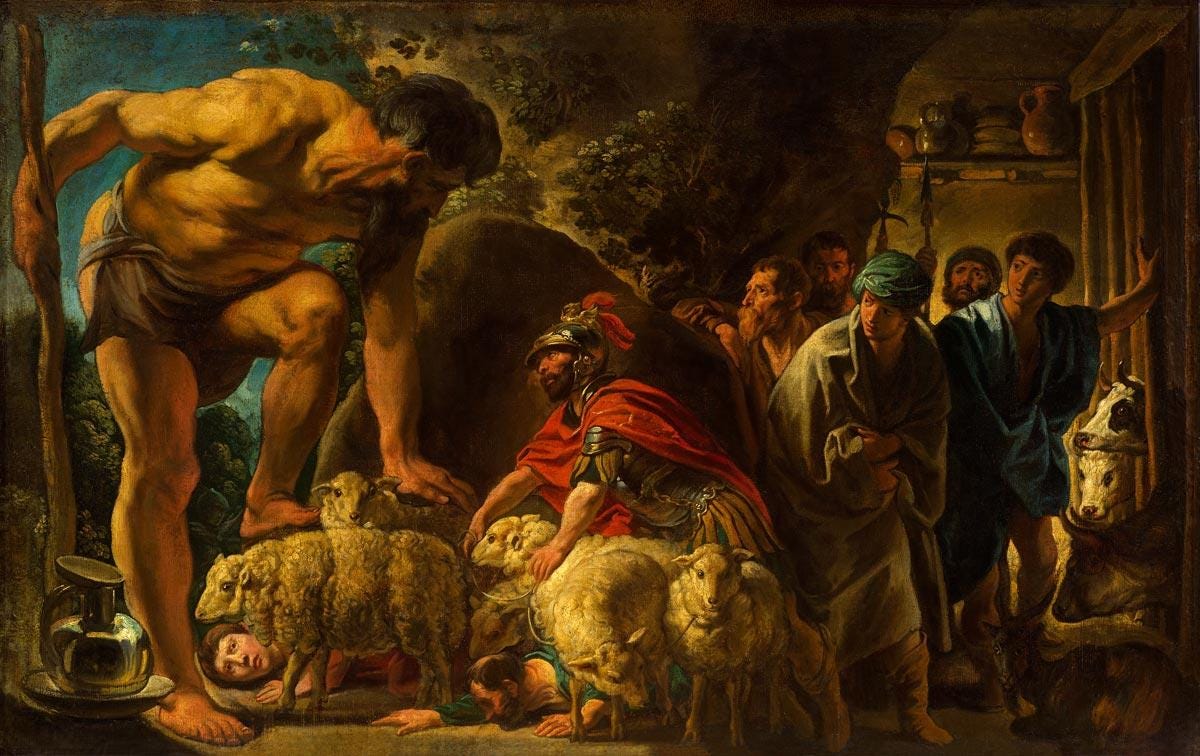
In the story, when Odysseus and his men land on an island looking for sustenance, they had no clue there was a giant cyclops named Polyphemus living in a cave making his own cheese and herding sheep who had an appetite for human flesh.
It was by far one of my favourite scenes in the film. The suspense, Polyphemus’ complexity, Odysseus’ leadership and stupidity (or maybe it was honour, not sure) was beautifully told. I also loved the puppetry of the giant.
The painting here feels much less menacing than the film. The giant is more idealised, the lighting and nature is flattering and picturesque, the proportions and perspective are skewed and unrealistic making this feel more like an illustration in children’s story book - I mean that in the best way possible.
Penelope Awakened by Eurycleia by Angelica Kauffman (1772)
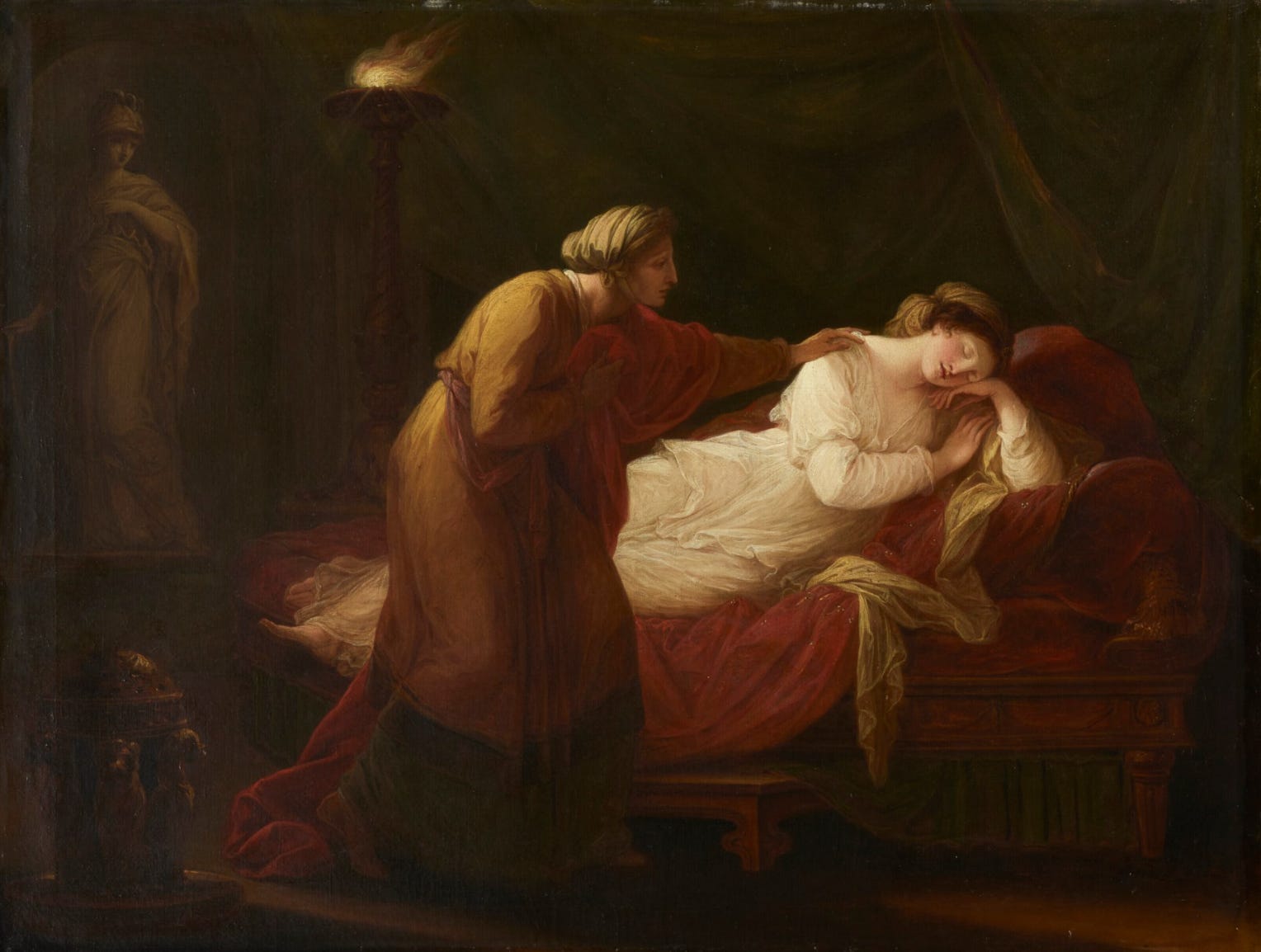
As the only woman artist on the list, I’m very interested in the fact that she chose to paint Penelope and Euryclea.
In the film it’s Euryclea who first realises the homeless stranger is Odysseus when she cleans his feet and sees his scar. However, she and Penelope don’t get many scenes together.
Here, Euryclea wakes a sleeping Penelope with the news that Odysseus has returned. It’s quite a gentle moment. Penelope resting is symbolic of how tired and weary she is having waited for her husband to come back and having to fight off those power hungry suitors. Also, the lighting and drapery is stunning.
Ulysse and Nausicaa by Louis Gauffier (1798)
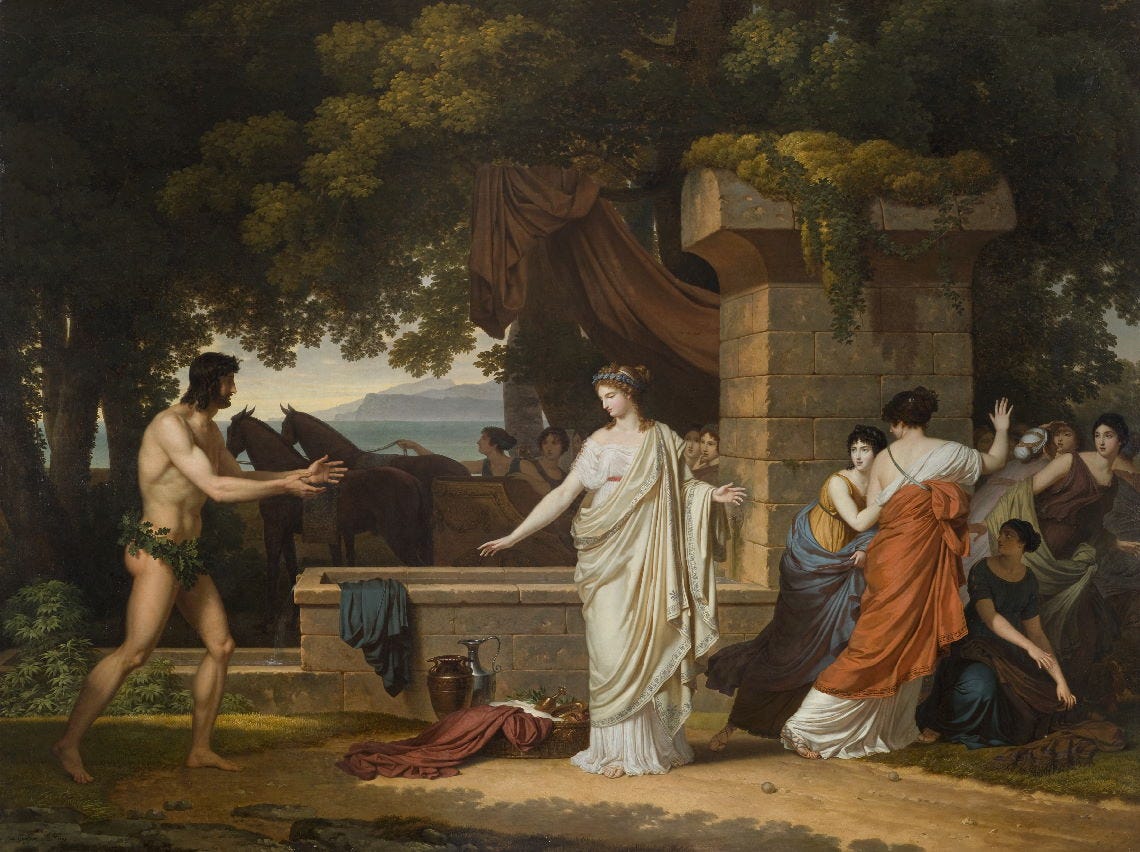
Unfortunately, the story line of Nausicaa wasn’t included in Nolan’s adaptation of the film. One can understand while from a pacing, plot, and length perspective, but it’s an interesting storyline, nonetheless.
As depicted in the French painter Louis Gauffier’s work, when Odysseus is shipwrecked in the in the utopian island of Phaeacia, he meets Princess Nausicaa who shows him mercy leading him to her parents and guiding him on how to gain their favour. The painting really illustrates her bravery and kindness, standing tall and welcoming him while the other woman turn away in fear and disgust.
It’s fine that Nolan chose not to include Nausicaa. Hayao Miyazaki was so inspired by the story of Nausicaa that he dedicated a whole manga and film to her, Nausicaä of the Valley of the Wind. The story is his interpretation of her in a post-apocalyptic world, one that she navigates with courage and deep understanding.
The Apotheosis of Homer by Jean-Auguste-Dominique Ingres (1827)
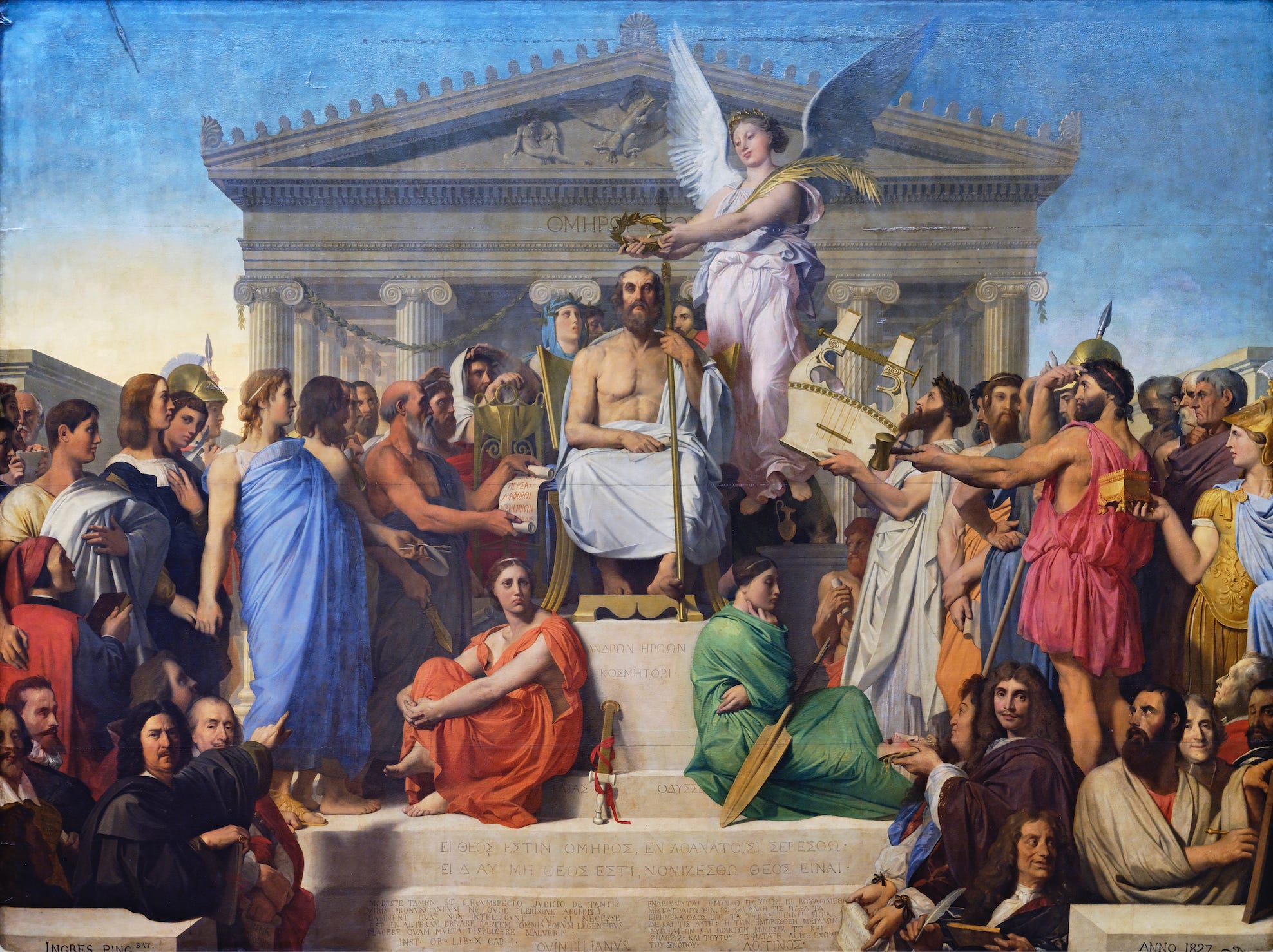
So, I cheated here a little. Ingres’ neoclassical masterpiece (I love a neoclassical anything) isn’t a direct scene from The Odyssey. It is an homage to Homer as the figurehead, source, inspiration of Western art literature and civilisation.
Here Homer has been elevated in the painting into an almost godlike status, given that his epics are considered the foundation for so much of western arts and culture. He’s surrounded by other great figures of the western canon who owe their craft to him – they include Aristotle, William Shakespeare, Raphael, Socrates, Plato, Mozart and more. The two women at the foot of his seat are meant to be personifications of his two greatest works, the Iliad and the Odyssey.
Ulysses Deriding Polyphemus by Joseph Mallord William Turner (1829)
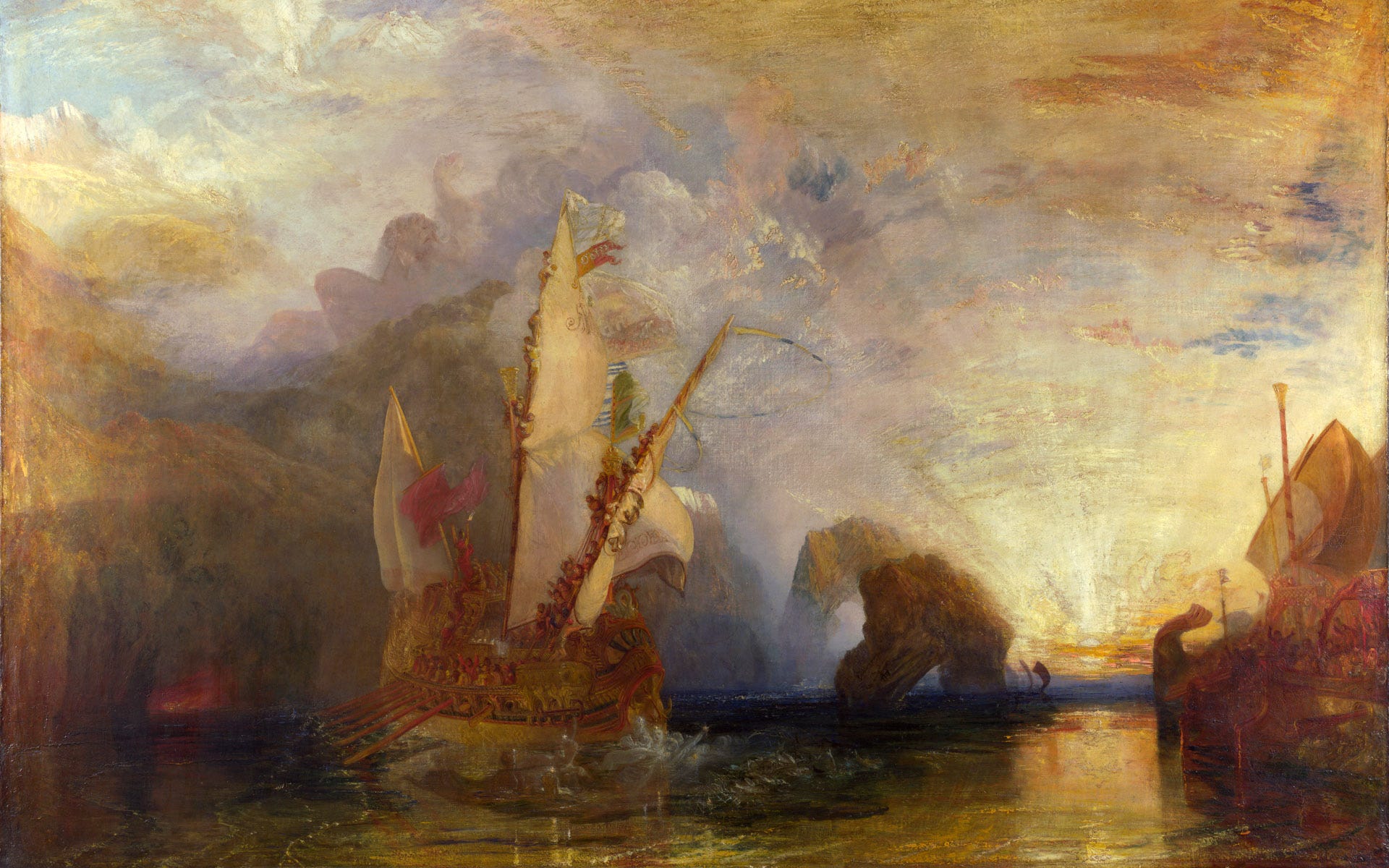
A stunning work, one that says so more about the environment, the physical word of the story than perhaps the story itself.
It supposed to depict Odysseus standing on his ship (you can see him there wearing red) arms over his head in victory after beating Polyphemus the giant cyclopes. It’s hard to notice this as the eye is drawn to Turner’s radiant portrayal of the sky, the lavender golden clouds and the sun busting over the horizon.
Not sure if this is the point but the painting really emphasises how small Odysseus and his triumph is compared to the grandeur of nature, of the greater world.
Odysseus and Calypso by Arnold Böcklin’s (1882)
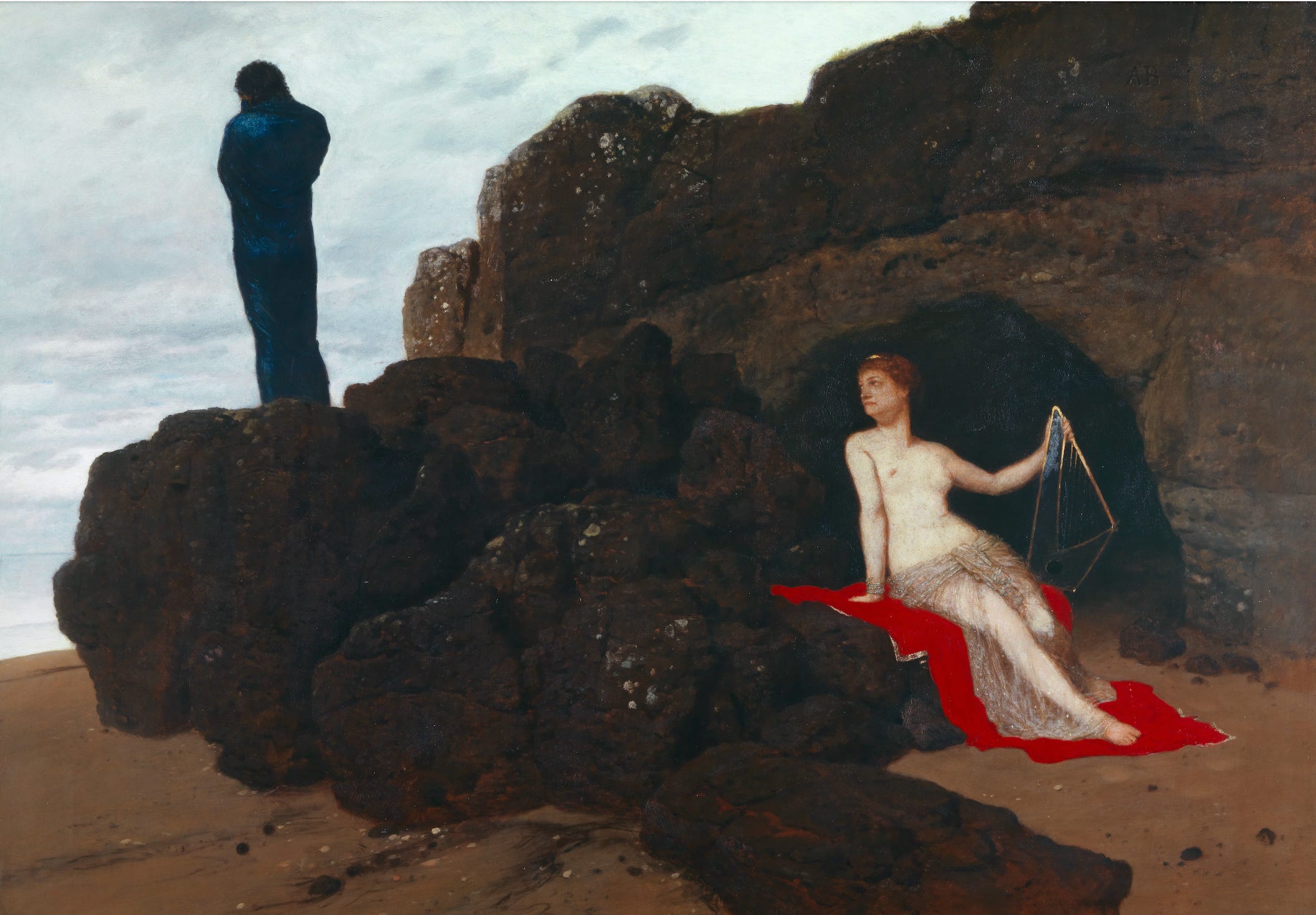
Filmic, deeply phycological, absolutely captivating, Böcklin does so much here with a powerful composition and clever use of colour to tell a story.
Nolan’s adaptation of Calypso was less nefarious and much more understanding than the source material. Here, Böcklin chose to depict Odysseus looking out to shore, contemplating departure after seven years on the island with Calypso, a very different Calypso than the film. Her pose is longing, fill of desire for him but in her face worry that he will leave.
The bright red of her blanket, the dark blue of his clock, already reveal their very opposing states of mind and intentions of each character.
Ulysses and the Sirens by John William Waterhouse (1891)
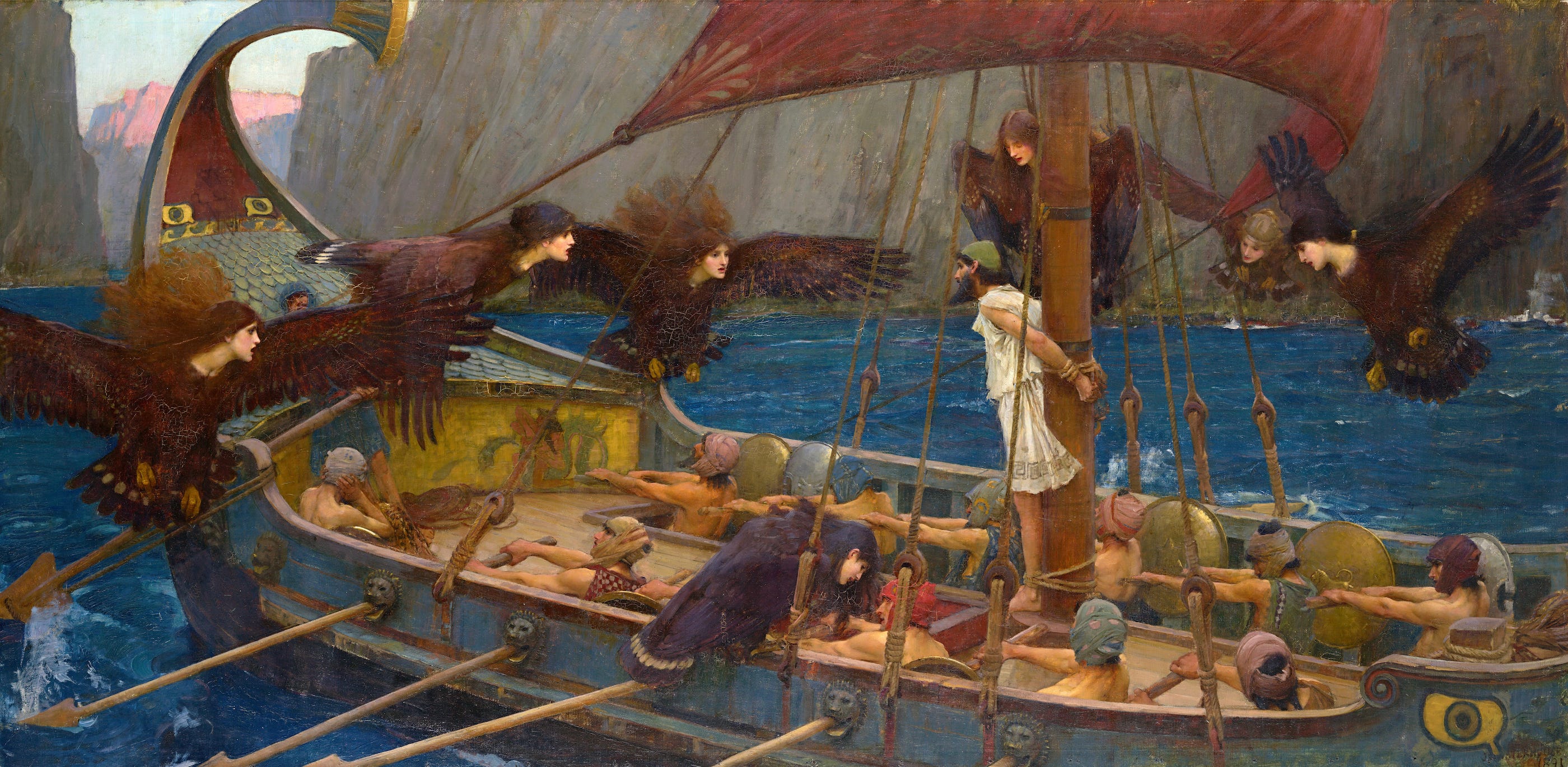
This has to be one of my favourite on this list.
In the film, Nolan didn’t show the sirens as the attempted to lure the crew through their song. In a way this made them feel much darker and intriguing. We were able to hear their song, experience their power, through Odysseus’ expressions when he tied himself to the mast. He was the only one without wax in his ear as he wanted to experience their song and live to tell the tale.
One of my favourite lines from the film was by Odysseus in fact describing the siren song:
“It’s the song of all the failed promises I failed to keep.”
Now Waterhouse, chose to paint them as bird creatures with women’s heads – a very controversial choice at the time as audiences were expecting to see more seductive mermaid-like nymphs. However, in early Greek pottery sirens were portrayed as half-bird, half-woman.
I wonder if Elon Musk will depict the half bird siren for his “historically accurate” AI version of The Odyssey.
Ulysses and the Sirens by Herbert James Draper (1909)
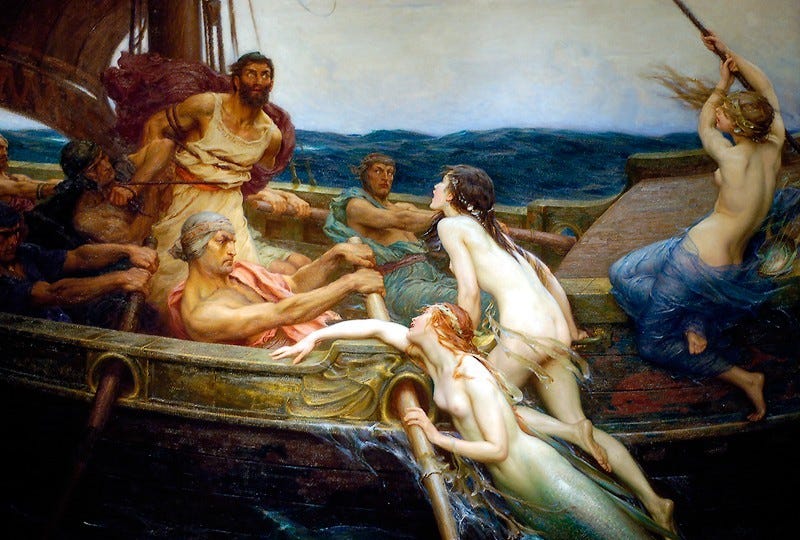
This I suppose is what they people wanted to see. A more sensual depiction of sirens, because having seductive voices wasn’t enough, they have to be in the nude to drive men into madness.
To be fair to Draper this depiction, the sexualisation of the sirens as beautiful mermaids, was the norm within the Victorian and Edwardian eras. He was just giving the people what they want really.
Looking at this work, painted 18 years after Waterhouse’s depiction of the same scene, makes you appreciate how revolutionary, or dare I say rebel, Waterhouse actually was. It’s also another example of how adapting a story can produce variously different works.