


When my nine-year-old, cricket loving, can’t stay still for longer than literally two seconds Godson, told me he was reading a book that was a “page turner,” I ripped it right out of his little hands.
After years of poorly disguised enthusiastic “let me guess, you got me a book for Christmas?” I was curious to know what book had got him as hooked as The Hungry Caterpillar did when he was a toddler.
He wasn’t wrong – the book I took from him that day was indeed a delightful page turner.
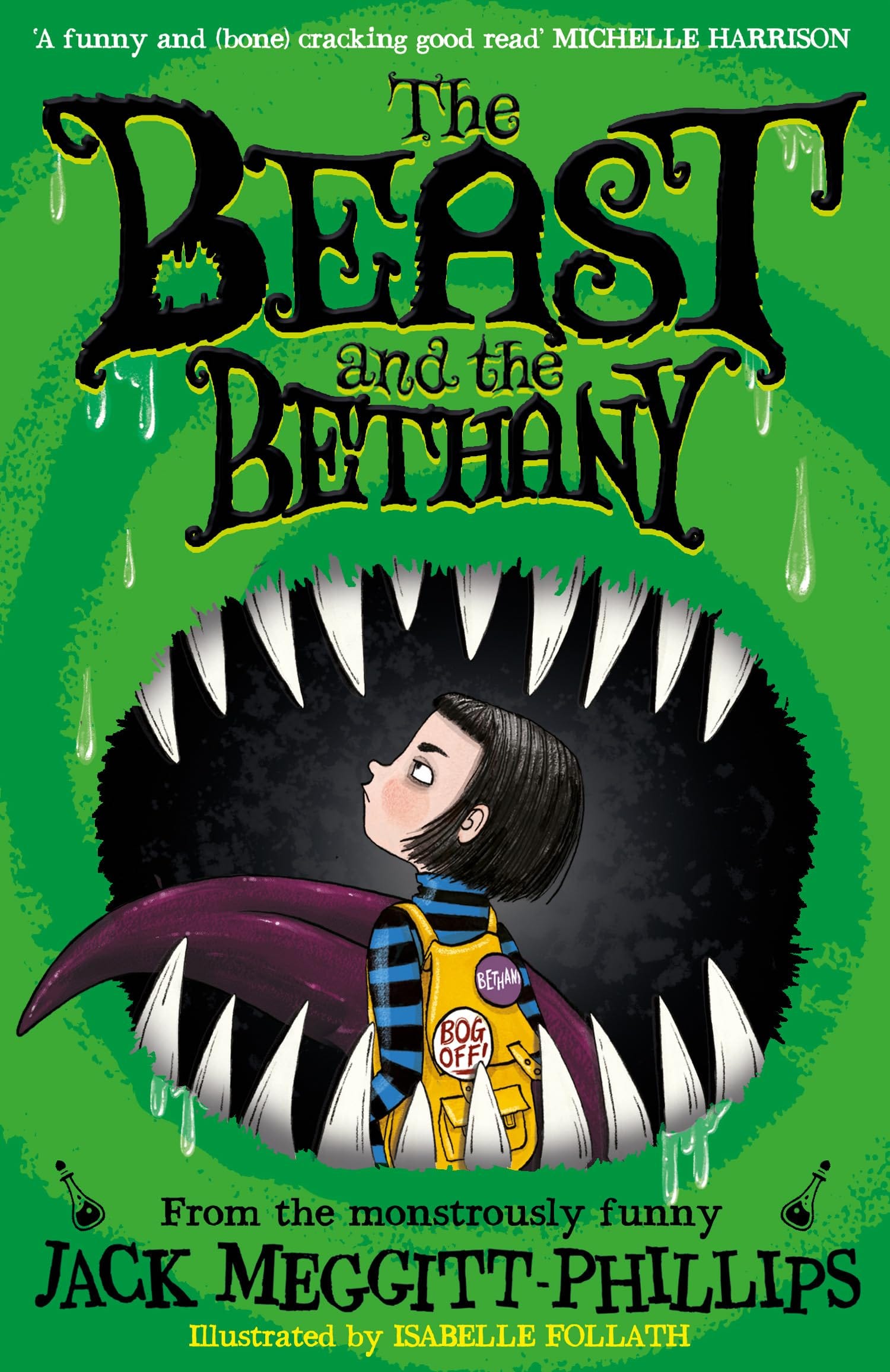
The Beast and the Bethany by Jack Meggitt-Phillips, while aimed for the 8–12-year-old demographic is a brilliant read for any age especially if you love sharply funny, dark, interesting, and thoughtful stories with fleshed out, nuanced characters.
It was one of the best books I read last year in the children’s middle grade fantasy horror space and it’s definitely a series – which there are five books all together – that I plan to finish.
The story follows Ebenezer Tweezer, who at 511 is youthful, beautiful, and incredibly stylish. His secret has nothing to do with a 12-step skin care routine but a beast he feeds in the attic of his mansion, who in return for absolutely outrages cravings keeps Ebenezer young and Facetuned.
But things take a turn when the beast announces that he’d like to eat a child. In his panic, Ebenezer finds the worst child he can to feed the beast. To be fair to him, it’s not a bad plan.
Bethany, the child, is a lot more than she seems. Sure she’s rude, naughty and incredibly unpleasant – but there’s something else about her that’s making Ebenezer rethink his plan. Oh no, are they friends now?!
I had the absolute pleasure of sitting down with Jack Meggitt-Phillips recently at the Emirates Airline Festival of Literature and we got to talk about my favourite topics - the power of storytelling, the darkness in children’s literature, the brilliant Hugh Grant and how to keep a reader engaged on every page.
Enjoy our chat in the video above or read the transcript below.
Please note: some of the text below has been edited for readability.
Maan: So I want to ask start off by asking you a very simple question, potentially, what is more difficult, starting or finishing?
Jack: Oh, definitely finishing. It is starting. I That's always the most exciting part. I mean, whenever I'm writing a book, I always start because normally with the first sentence, yeah. And so a first sentence would intrigue me. So for the beast of the Bethany, I had this sort of sentence rattling around my head for a bit, which was Ebenezer tweezer was a terrible man with a wonderful life, and that that sort of intrigued me.
Maan: So that sentence was just there.
Jack: It was just there, and then I was just thinking, I wonder who this Ebenezer tweezer is. And it sort of went from there.
It's very exciting when you're writing the first draft and sort of racing to the end, but when you're actually working on editing it and sort of making it, giving it the polish that it needs to be a good book. That's always a part where you want to sort of tear your hair out of it.
Maan: Be a bit of a perfectionist with it.
Jack: Definitely plays into my perfectionist tendencies, that last editing stage where I get very obsessed about commas and what sort of thing.
Maan: So you start - no spoilers - you start the first chapter of the first book with what I would say, and I mean this in the greatest compliment - a dark scene. I wonder. Why do you think children love the dark?
Jack: That's a good question. I think that one of the great sort of joys and benefits of children's literature is it gives children a way to experience some of the sort of darker aspects of life in a sort of controlled way.
Quite often if there's a terribly bad villain in a children's story, they're vanquished by the end. It's not there to show you that darkness exists, but it's that darkness can be defeated.
And I think why children enjoy it… I think when they're reading something and they feel like they're getting away with it, they are reading something that's entertaining rather than informative.
It makes reading feel like more of a pleasure than something they've been told to do.
Maan: You’ve been a Roald Dahl fan growing up. His stories are very dark, and some people feel like they're too dark for these days, right? So I wonder for you, as a writer who's writing a story that has some fun, dark scenes, when do you know when to pull back the darkness? Do you ever feel like, as a writer, like, oh, this has been exciting to get really, really like deep with this. When do you know what to pull back, or do you pull back?
Jack: My first draft of a book will go way too dark, and it'll be almost like a Quentin Tarantino-esque version. And then normally, I notice it myself, and I pull back.
But what I found is that quite often - let's say, you have a scene where someone gets their head chopped off by a pair of scissors, and that's sort of quite dark, and then you think, ‘oh, I better make it into something different,’ and you end up coming up with something more fantastical. Quite often, the fantastical version is actually scarier and better because it uses the imagination more.
I think what you write is what your influenced by as a reader. And I loved reading books where you felt that sort of slight shiver of terror, and then the next moment you're reading a scene that's hopefully funny.
I think comedy and horror work together very well. Because both of them are sort of designed to do something. If you're writing a good comedy and no one laughs, well, it's not a good comedy. If you're writing a horror and no one screams,it's not a good horror.
Maan: So, you want them laughing and screaming is what you’re saying.
Jack: Exactly every page I need laugh, scream, laugh, scream, laugh, scream, and then everything that isn't doing that you just got to cut it.
Maan: So we were talking about my Godson before. I have to say that I'm always buying my God children books. Yes, every Christmas they're like, Oh, we know what you're getting us.
Jack: You’re Us very good godfather. Well done.
Maan: You would think, right? I try and wrap it up to be like, to hide the illusion of it's a book. But they always know it's a book.
And he's like, a nine year old loves cricket, loves be outdoors. He's very active. And he came to me one day and he was like, ‘Uncle Maan, this book’ and I quote, ‘is a page turner.’ And I think that is the highest form of compliment a children’s author can get.
Jack: I mean, to be honest, it's so surreal even now, and I’ve been doing it for a few years - when you whenever you see a children's sort of reading your book somewhere that you're not expecting it, and you see them sort of tearing to the pages. It just makes everything worthwhile. And that's just such a wonderful experience. I'm going to have to take that quote and put on the next book - ‘Adam says it's a page turner,’ that's good.
Maan: My question from that is like, especially, you know, these days, you want to keep the reader’s attention from every page. Particularly for children, who are, I think the biggest critics like if you cannot capture a child's attention, you know, that story is not great.
So I'm wondering, from my godson's very wonderful compliment and review of the book - how do you as a writer really try and think about, how do I keep that kid who, competing with a PlayStation or the phone or whatever - engaged in every page, every word.
Jack: There are lots of authors who sort of plot their books quite meticulously. I'm very much someone who just writes and sees where the story goes. If I'm writing a chapter and I'm enjoying writing it, when I read it back later on, I can see, oh, this is going to be enjoyable to read, because I was writing it so quickly.
It's a sort of similar experience me writing and reading. It's just sort of following the story. That's the exciting part.
In terms of how to sort of write those sort of page turning things, I think the quicker you can get into the story… quite often you'll read books, and there'll be this big, sort of long introduction, and then the story begins.
If you can jump into the most interesting part of your story immediately, that's how to hopefully encapsulate their attention.
Maan: I think it's really interesting what you that you are not a writer story who plots are you discovering the story as you go? Is what you're saying?
Jack: Yes, which when it goes well, it feels like flying. It's wonderful. You think, oh, I didn't realize this was going to happen, but it fits in perfectly. But then quite often, because I don't plot books, I'll get about a third of the way through and think, Oh, yes, this isn't very good - this has no story that I can do.
Sometimes sometimes I feel a bit like a mad scientist sort of mooching potions together And then sometimes it accidentally comes off and it's the book, whereas other times you think, Oh, I've made some sort of strange omelet.
Maan: This is one of five books, the first of five so does that mean that you didn't know you were going to have five? Did you know what the end was the end? Did you have to plot or plan how many books when you wrote the first book?
Jack: It sounds, you know, a bit cliche but when I wrote the first book I was generally writing it for my own enjoyment, and then when it had the interest of publishers wanting to actually publish it, it felt like such a wonderful surprise, I never thought that much ahead about whether there'd be a sequel.
And then when we talk about the next book, I kept on thinking about these characters, and I missed them and I want to spend more time with them.
And then in terms of when you write a series, there are certain scenes I've had in my head that I thought I would like to write, like the ending of the whole series that's been in my head for a few years.
Maan: Must have been very satisfying.
Jack: It was. It was such a strange experience writing it when you've been thinking about something for so long. So I had sort of rough ideas of where the story was going to go. But when you actually come to write it, you don't know whether those ideas are going to fit or not.
Maan: Is it more difficult to be nuanced when you're talking and writing about evil and the dark side, as opposed to making it very black and white? Because the way we can get black and white might be much more palatable for younger readers.
Jack: It might be more palatable. The books that I loved reading when I grew up, as well as the Roald Dahl ones, were the Lemony Snicket’s A Series of Unfortunate Events series. What I love about that series is, towards the end of the series, the heroes, the Baudelaires, start doing unspeakable things. The boundaries between the heroes and the villains are blurred.
When I was writing The Beast and the Bethany, I thought it would be interesting if the reader didn't know whose side they were on. So at the beginning, we meet three terrible characters - we've got the beast who likes eating everything from King cobras to crown jewels, we've got its butler, Ebenezer, who is an incredibly vain man who loves his own reflection more than anything else. And then you've got the beast’s next meal, Bethany, who's the worst behaved child in the world. And I thought it would just be so much more interesting for the reader if you weren't quite sure where you wanted to go.
If I've written it right, hopefully, when you meet Bethany for the first time, you sort of think, actually, I wouldn't mind if she gets fed to the beast. And as the book goes on you learn more about all of them.
I'm really glad that the sort of friendship has come through as a theme, because those are some of the most relationships in my life.
I think by the end… sort of this question of whether two bad people - really, if you got two bad people together in most stories, they would become super villains - but seeing them change each other just because of their friendship, that was one of the things that surprised me as I was writing it, and something I'm really proud of, how that sort of thread came through.
Maan: Have you ever read Howl’s Moving Castle by Diana Wynne Jones?
Jack: I'm reading a lot of Diana Wynne Jones at the moment.
Maan: I love her, she’s brilliant.
Jack: The book I've just read The Chrestomanci series those are a similar in that there's a sort of blurring of the sort of the good and the bad. And I think those sorts of children's books, I'd love to see a lot more of.
I think it's more true to children's own experiences. They see adults being good and bad, and they see their friends are a mixture of the two. And I think if there were more books which actually showed that there aren't heroes, there aren’t villains, they were all a sort of weird hodgepodge of the two, then it becomes more interesting. Hopefully.
Maan: I would suggest you read house Moving Castle, if you have the time, and also watch the animated film. Have you ever watched any Studio Ghibli films? You know Spirited Away? Yeah, he did the house Moving Castle. It's like a brilliant adaptation. It's like its own beast. It's wonderful.
Jack: It's based a bit in Wales. Yes, I definitely need to read it as a Welshman.
Maan: So speaking of books that we like reading? Is there a book that you always come back to and read?
Jack: I think the perfect book is Christmas Carol by Charles Dickens.
Maan: I love it's on my list, my list of one of those books that I always go back and read or listen to, actually, now audible Hugh Grant has done that. Have you heard it?
Jack: my job at Christmas is to peel the chestnuts. And every year I listen to Hugh Grant while peeling them.
Maan: He’s great.
Jack: Well, I might be getting too sort of philosophical about it, but I think that plots and the book is, made out of plot or story. Plot is what happens, and story is why it happens. I think A Christmas Carol is a perfect example of that.
The plot is the fun stuff of the sort of ghosts coming and visiting and the story is seeing this man re evaluate his whole life. The flow of the story is so fantastic. Whenever I go back to it, there's always something new.
There's a quote about how a classic is a book that's never quite finished what it's trying to say. And I think that's very much the case for A Christmas Carol.


