


I recently re-watched The Devil Wears Prada and a few things stood out on why it really is such a brilliant film.
Aside from the editorial treatment, fun plot, the fashion, and great performances all around, the main reason The Devil Wears Prada is still relevant and entertaining 20 years after its release, is the writing.
It is a truth universally acknowledged that writing, and only good writing, is the basis of what makes a film, or any story, excellent. And to be clear, by writing I mean plot, scene, pace, character and charter development, and, perhaps most importantly in film, dialogue.
When the writing is good its undetectable. It doesn’t feel written or performed but an extension of the character themselves. And sometimes, when the writing is so excellent, the dialogue lives on beyond the screen and the characters who said them.
From Shakespeare’s “All that glisters is not gold” in The Merchant of Venice, to “Frankly, my dear, I don’t give a damn” in Gone with the Wind, to “I’m not a regular mom, I’m a cool mom” in Mean Girls, good writing can create real influence on culture when it filters into the mainstream vernacular.
This is so the case of The Devil Wears Prada.
The film was wonderfully adapted by Aline Brosh McKenna from the novel by Lauren Weisberger. It was almost perfect. My only criticism, and I’m not alone in this, were Andy Sach’s insufferable, unsupportive friends (they treated her worse than the models at Runway) and, of course, Nate the horrible “That’s like $8 of Jarlsberg in there” boyfriend. That was definitely a blind spot in the writing.
Apart from this, re-watching the film made me appreciate how clever the dialogue was workshopped and delivered. The memeification of phrases such as Florals? For spring? Groundbreaking to by all means, move at a glacial pace, you know how that thrills me, and of course, the now iconic cerulean dress monologue, has turned The Devil Wears Prada into one of the most online quoted films in recent memory. It feels almost universal. And this is mostly thanks to Miranda Priestley herself since it’s her sharp one-liners that are the most popular.
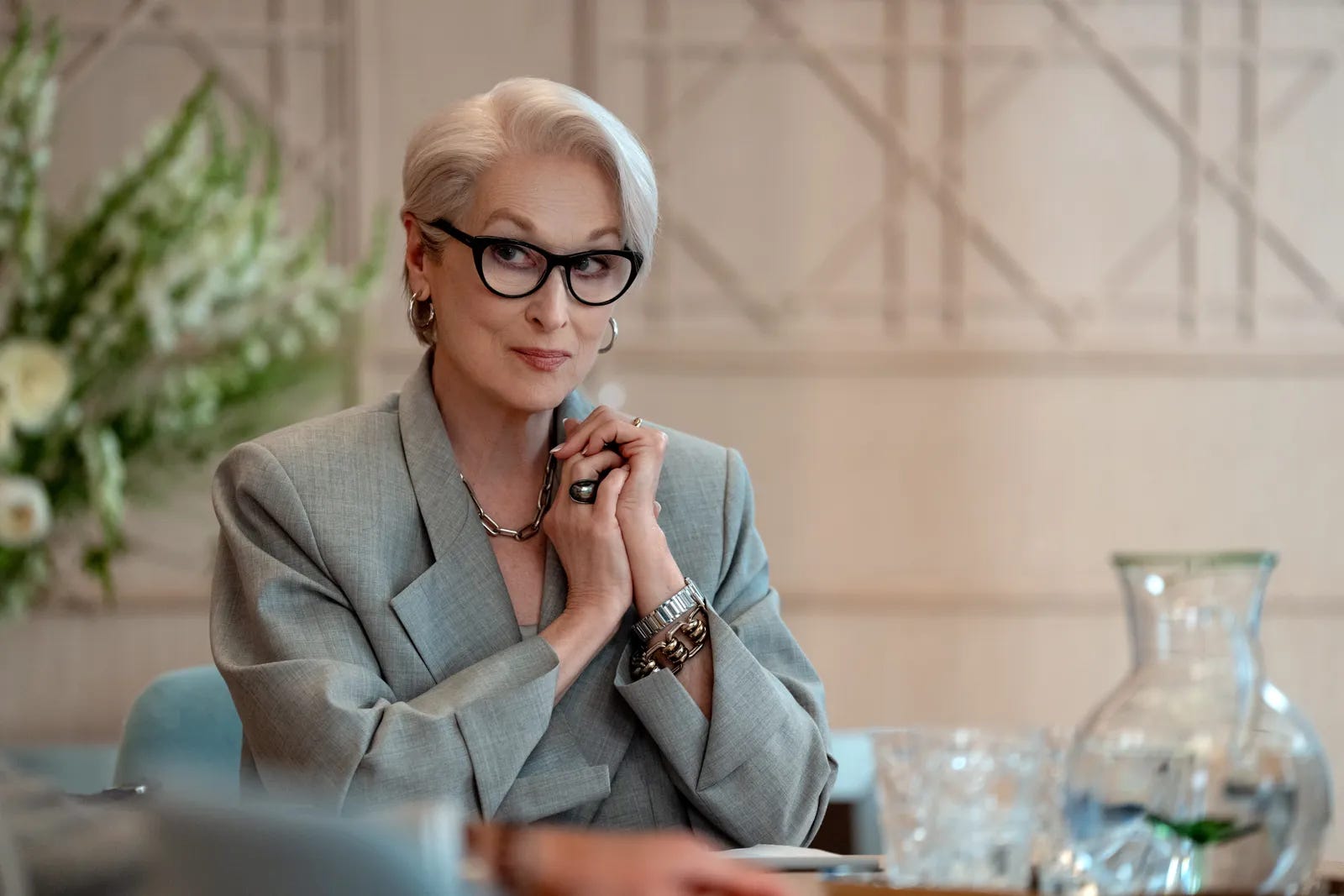
In fact, here’s a hot take. Andy is not the hero of the film, Miranda is. Sure, Andy is who we follow, the one with character arc, but we are watching for Miranda, the film centres around her, her life, her reactions, her thoughts, hers is the only opinion that matters – lest we forget.
Which is why, I remain dubious fighting off my instincts teetering on the edge before deep diving into a full rant of, this film is going to be so bad.
The second trailer for the sequel, out in early May, was released earlier this week, and while brief, it showed me enough to think uh oh.
Based on the officially released text about the film, the sequel “Follows Miranda Priestly’s struggle against Emily Charlton, her former assistant turned rival executive, as they compete for advertising revenue amidst declining print media while Miranda nears retirement.”
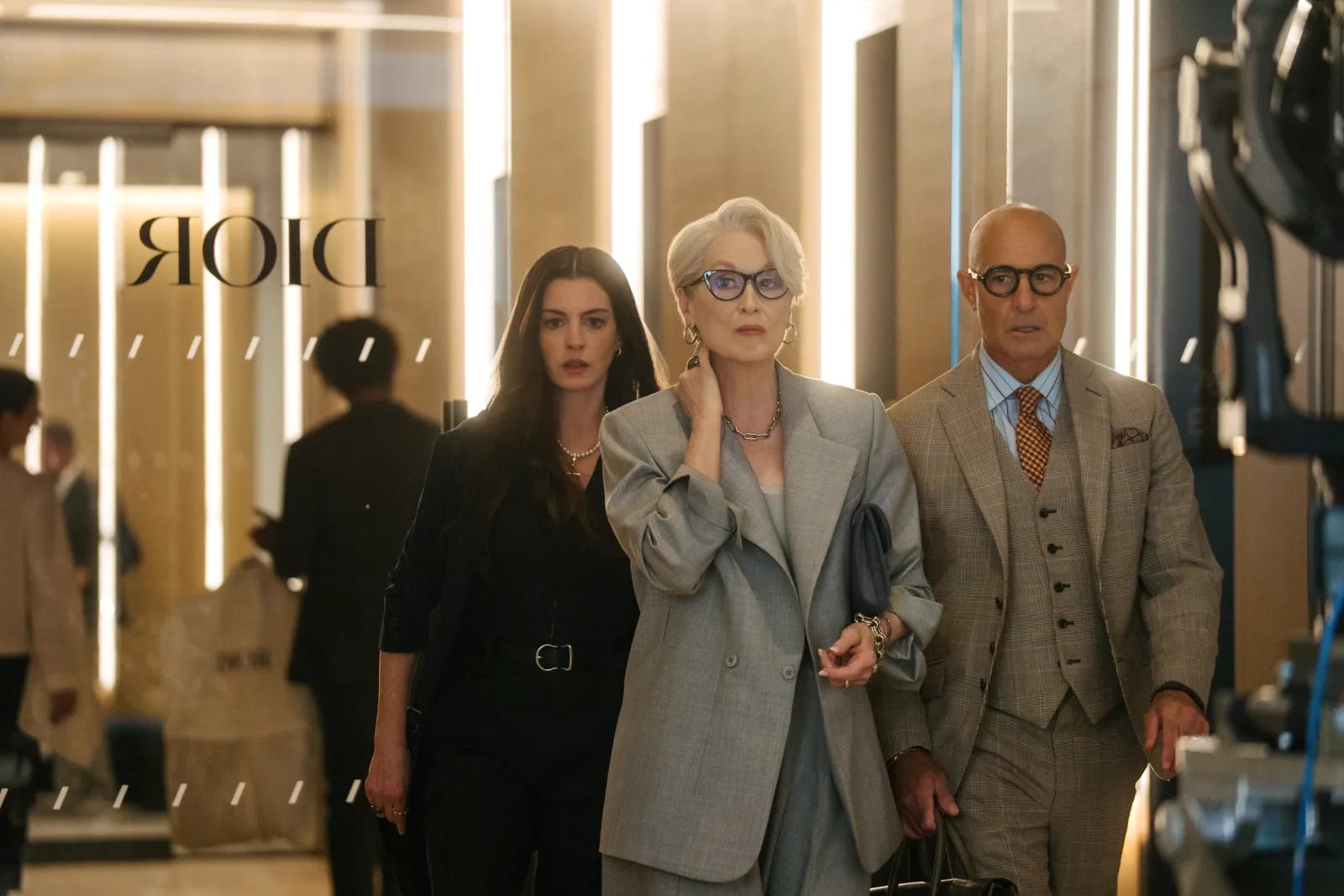
See how here, Miranda is positioned as the main character and Andy doesn’t even get a mention? Further research on the premise of the film reveals that Andy returns to Runway as a features editor of some sort and “helps Miranda navigate this new and suffering media landscape. Emily, who is now the head of a luxury brand that possesses funding which could ensure Runway’s survival.”
From a premise perspective, this makes no sense. To be clear, writer Weisberger did write a sequel novel, Revenge Wears Prada: The Devil Returns in 2013 where Andy and Emily start a wedding magazine called The Plunge (terrible name). The novel focuses on Andy’s new life as a bride to a media heir. Miranda is lightly featured in the novel – which makes the title of the novel rather reductant. The novel wasn’t well received and from my understanding the sequel of the film isn’t based on the events of the novel.
For the purposes of this essay, I’m focusing on the idea that the film sequel and the world and characters it presents is based on a continuation of the first film and that these exist as their own standalone universes, unattached to the books they are adapted from.
Based on this, the premise of the second film is already off. What I liked about Andy in the first film is that she was not a fashion girl. And while the fashion world touched her life, influenced her perspective, and maybe even her taste, she chose to leave that world, rather dramatically, behind as she was losing her way and purpose.
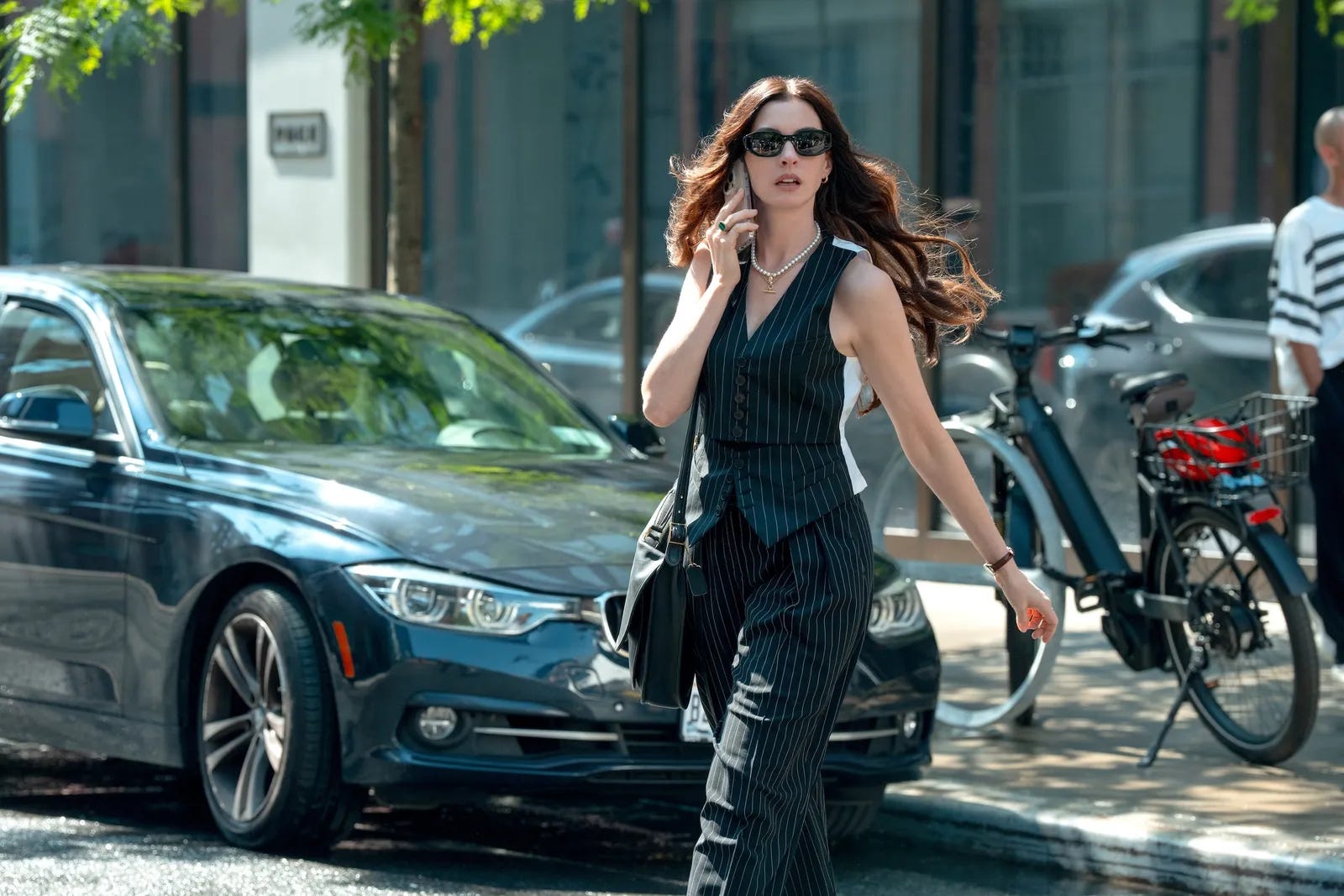
Andy wanted to be a serious journalist, so it’s odd that she would leave only to return almost 20 years later back to Runway and look incredibly fashionable while doing it. I repeat, Andy was not a fashion girl. While I’m not denying the possibility of someone’s style evolving and even elevating over time, it’s hard to see this happen, in the way it’s presented through the trailer, to Andy.
What would have made a lot more sense is that if Andy made her mark as a journalist for The Washington Post, The New York Times, The Wall Street Journal or even The New Yorker. I could have also seen her become a successful non-fiction writer or even a documentary maker.
From a premise perspective I would have loved to a sequel where Andy was assigned to write a detailed profile, or even an autobiography on Miranda where she’s forced to shadow her for a few weeks. And from there, Andy sees Miranda, this steel figure in the fashion landscape unravel within a tumultuous shifting media landscape.
Andy would then discover Miranda’s humanity but also some delicious secret and find herself in a difficult position. Does she include said damaging secret in her profile and get a head or does she instead save Mirand’s reputation?
There would also be something interesting happening in Andy’s personal life, a husband and / or a child that she’s neglecting because, as in the first defining chapter of her career, Miranda’s gravitational pull is overwhelming.
This rather basic scenario has higher stakes than what the trailer presented. There was no story in the trailer, only a sequence of scenes where everyone looked absolutely fabulous and Miranda articulated a few one-liners that I think were meant to rouse us into excitement.
The trailer was mostly focused on this point in fact, Miranda and her zingers. What stuck out to me, almost instantly, was that her one-liners were not very good – not sharp, not funny, not unique, not memorable.
“I hope that’s not what you’re wearing tonight.”
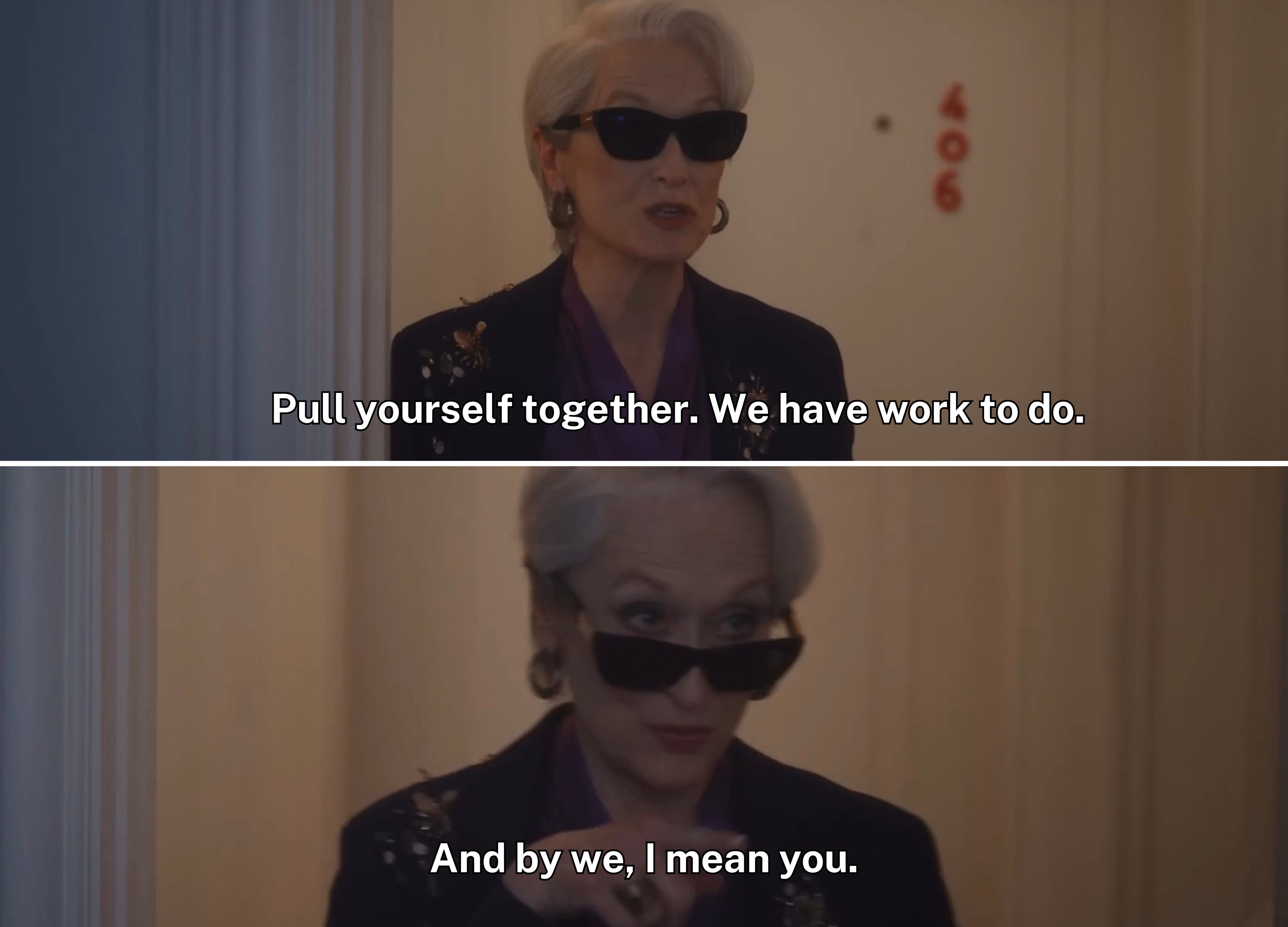
“Put yourself together. We have work to do. And by we, I mean you.”
Cliched. Forced.
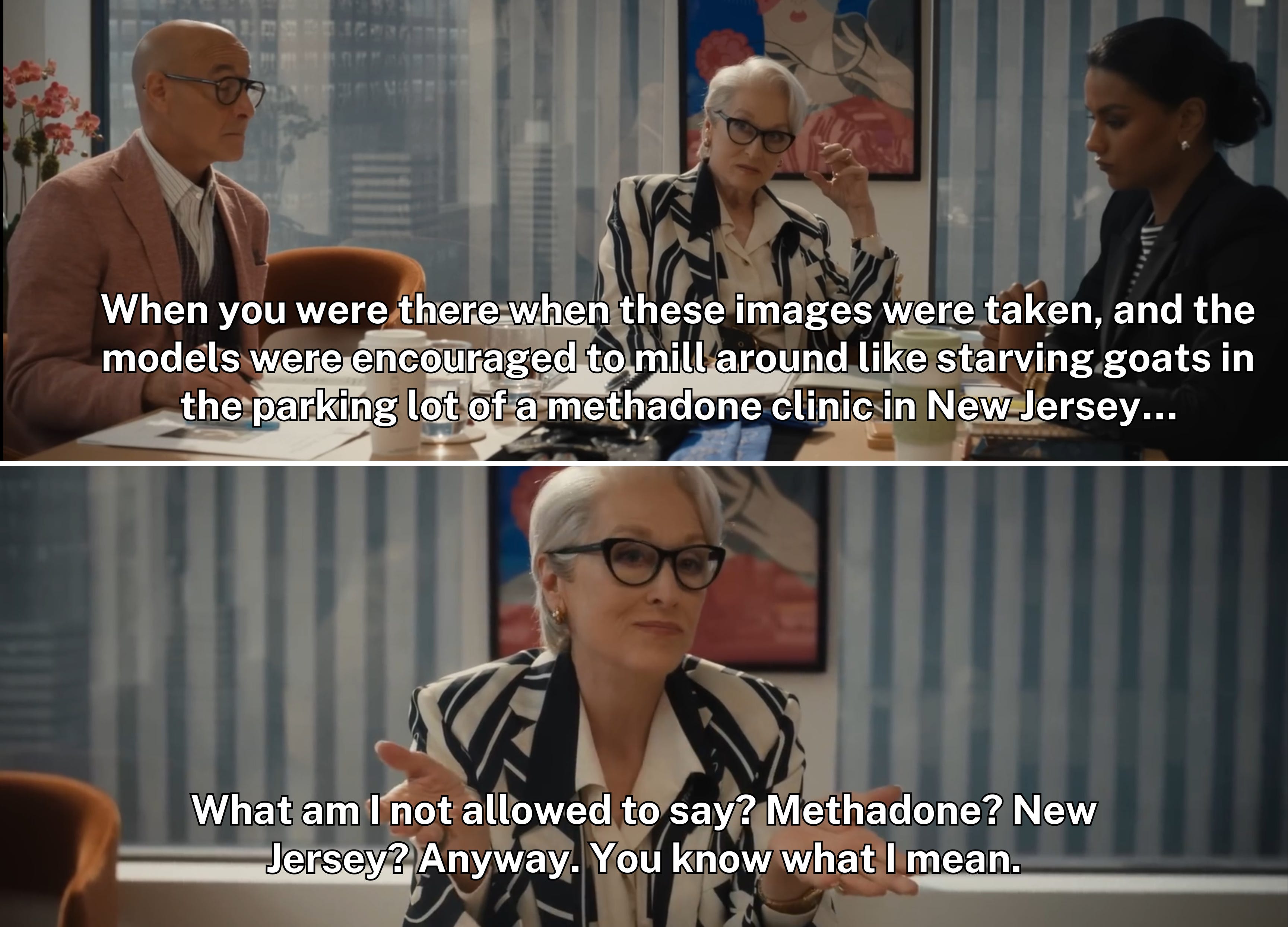
And then there was a scene where an editorial meeting was happening and Miranda asks:
“When you were there when these images were taken, and the models were encouraged to mill around like starving goats in the parking lot of a methadone clinic in New Jersey…”
Before what must be an HR type character, played by the talented and stunning Simone Ashley clears her through to which Miranda responds:
“What am I not allowed to say? Methadone? New Jersey? Anyway. You know what I mean.”
A boomer being corrected and forced into corporate woke-cation? Groundbreaking.
Miranda would not take kindly to any of that nonsense. I come back to the writing. The writing here has already revealed itself to be subpar compared to the first film.
A trailer is supposed to show us some of the best part of the film, just enough to get us excited to get out of the house and to the cinema. If this trailer is the best the film has to offer – vibes, overdone tropes and weak dialogue, then we are in trouble.
The appearance of Anna Wintour, the not-so-secret inspiration behind Miranda Priestly, at the 2026 Academy Award was interesting.
She was on stage with Anna Hathaway, and the whole bit centred around Wintour leaning into her fictional version. She ignored Hathaway’s question on what she thought of her dress and then referred to Hathaway as Emily. It was very good and blurred the lines between fact, fiction, stage play, and storytelling on various forms.
It revealed again that the themes the writing in the film explore, belonging, power, elitism, live very well beyond the film and were presented ironically in one of the most elite events of the year, at a time when great swathes of the world are literally at world with themselves and each other.
It was also brilliant marketing for the film.
I hope that’s not all the sequel will give us though, a series of great gags where all the good parts of the story are exaggerated and turned into a caricature of the first film, just for a money grab. Perhaps I’m naïve to think and write this, at a time when cinema is struggling, but The Devil Wears Prada is so much better than just a money grab.
It was meant to be a light-hearted and entertaining film, yes, but it became more than that, a cultural phenomenon, because despite posing all the glamour of the fashion word that would appeal to insta-hungry viral obsessed audience, the stakes were high, the story gripped us, and the writing was good.